
- Speech/Session Reports
Digest of the keynote session at the National Knowledge Manufacturing Conference Follow-up Seminar "Tackling Vietnam's Water Environment Challenges with Japanese Technology, Toward that End
2025.11.30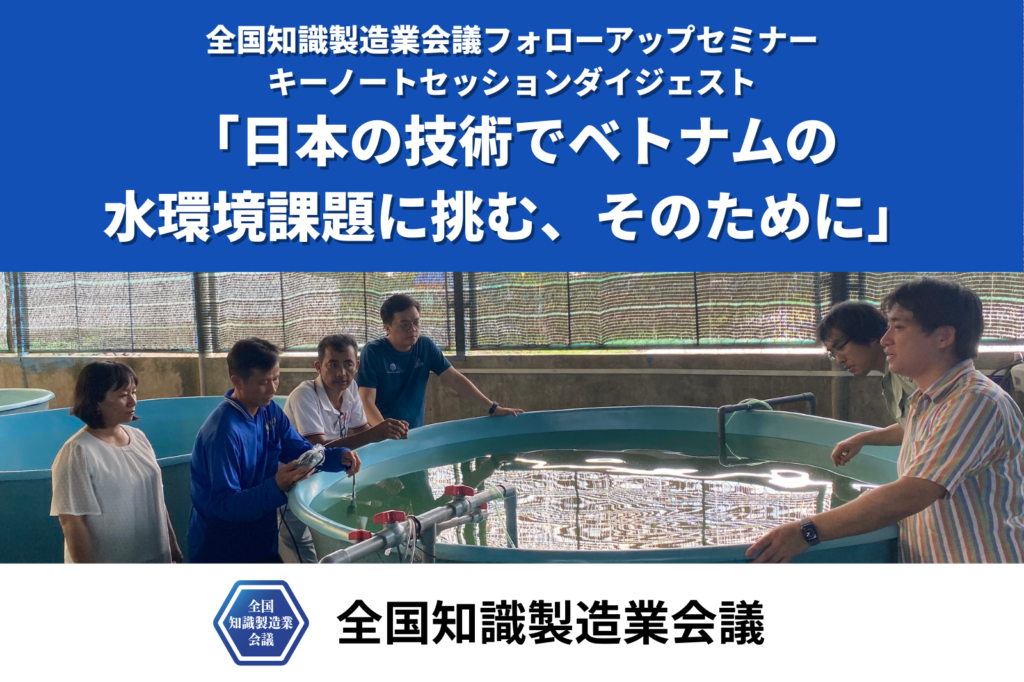
speaker
Mr. Tetsuya Inokuchi, Representative Director, Vantec Co.
Mr. Yoshi Sato, President, Inland Water Resources Research Institute Co.
Mr. Tatsuya Hirano, Corporate Banking Division, Mizuho Bank, Ltd.
Takashi Okazaki, General Manager, Manufacturing Development Division, Leave a Nest Co., Ltd.(Facilitator)
What is needed to further advance the ideas generated at the National Knowledge Manufacturing Conference? At the follow-up seminar, which was held with an awareness of these issues, many specific episodes unique to the participants were shared, providing a valuable opportunity to take the "next step" forward. This article provides a digest of the keynote session.
How to face the situation where the industry will not be able to stand.
Okazaki:Today's seminar will introduce case studies of two companies that are actually taking on the challenge of creating new products and services under the theme of "Deciding on the Next Step. The title is "Taking on the challenge of Vietnam's water environment with Japanese technology, and to do so. Mr. Inokuchi of Vantec, which was honored at the National Knowledge Manufacturing Award 2024, and Mr. Sato of the Environmental Inland Water Resources Research Institute will take the stage to share the background of their collaboration and the process of overcoming challenges through their challenges. Mr. Hirano from Mizuho Bank will also join us as a commentator. First of all, Mr. Inokuchi and Mr. Sato, please introduce yourselves.
Inokuchi:We have been introducing aquaculture sludge treatment services mainly in An Giang Province, Vietnam for the past five years, utilizing the technology, know-how, and experience in the environmental business that our parent company, Ritto General Industrial Co. Today, we are still connecting online from Vietnam.
Locally, the Mekong River is experiencing a serious decline in water volume and pollution from upstream, and the entire agriculture and fisheries industries are under pressure to change. In addition, the SDGs have led to stricter regulations on imports, and the industry itself is becoming unstable if conventional methods are used.
Given such an overall picture, there are inevitably limits to the sludge treatment technology we have developed in Japan alone. Therefore, with the cooperation of Leave a Nest, we are looking for new solutions, and we participated in the National Knowledge Manufacturing Conference as part of this effort.
Currently, we are focusing on "reusing sludge as a resource. Our aim is to realize a resource-recycling circular economy by combining it with agricultural waste. We are also trying to improve the production efficiency of aquaculture by incorporating the technology of the Environmental Inland Water Resources Research Institute, which we met at the National Knowledge Manufacturing Industry Conference.
Sato:As the name implies, the Institute for Environmental Inland Water Resources Research focuses on the conservation of ecosystems in the inland water environment (rivers, lakes, marshes, and other freshwater areas). I myself am originally a specialist in metallurgical engineering, but I have been working on improving water resources because I believe that I can apply my knowledge of metals to the field of biology and the environment.
In addition, Aqua Solutions Corporation, which I also manage, possesses the core technology of a swirling fine bubble generator. We are utilizing this to shorten growth from six months to three months in normal aquaculture. We are also developing other technologies to increase productivity while reducing waste and environmental impact, such as increasing seaweed by submerging blocks in the water.
Our ultimate goal is to create a situation in which eels that once inhabited the Mogami River in Yamagata Prefecture, where we are based, return to the river.
Seeing the site and sharing the real feeling is essential for collaboration.
Okazaki:The two of you met when you had booths next to each other at the National Knowledge Manufacturing Conference. I heard that their collaboration was born out of a common awareness of the issue of water. Mr. Inokuchi, who was already operating a business in Vietnam, asked you if you would like to visit Vietnam.
Sato:At first I was surprised, but I immediately decided to go. By coincidence, I had visited Thailand a few months earlier and had experienced the poor quality of the water used for shrimp farming there. Wastewater was flowing through the city, and I could smell the odor in the air, and I thought, "This is not a good situation. So when Mr. Inokuchi approached me, I wanted to see for myself whether that condition was a common issue throughout Southeast Asia.
Okazaki:Did Mr. Inokuchi pay for the travel expenses for the inspection?
Inokuchi:That's right. We are working within the framework of a subsidized project, so the cost burden is not that great, but the biggest reason is that "we can't start without having people see what we do onsite. No matter how many materials we use to explain the project, there are many aspects that cannot be conveyed by that alone. We thought that having people actually see and feel the work was the most important way to promote collaboration.
While taking advantage of various systems, the first step is to take the risk ourselves.
Okazaki:As a result, a project to improve the efficiency of aquaculture and water quality using fine bubble generators was initiated between the two companies. I accompanied Mr. Inokuchi on his inspection tour of Vietnam, and thanks to the network he had built up over the years, the decision to conduct demonstration tests went smoothly with local universities, large-scale aquaculture businesses, and companies involved in environmental assessments. Did Inokuchi-san bear the costs of the project as well?
Inokuchi:Yes, we did. We made a plan on our side and proceeded with this also with the help of subsidies. No funding was provided by local companies. We believe that the first step is to take the risk ourselves.
Okazaki:I see. I would very much like to hear the opinions of financial institutions on this point, but how do you view this kind of initial securing of funds, Mr. Hirano?
Plain:This is common with the "0 to 1" startup support, but honestly speaking, it is difficult for a bank to provide support in the form of loans in the early stages of a new business. However, there is support from the Japan Finance Corporation, guarantee associations nationwide, and local government loans. Therefore, we often give advice on how to combine such systems.
Take risks, be bold, ask for advice."
Okazaki:I understand that you are now at the stage of producing fine bubble generators on site after the demonstration. What are some of the challenges you are currently facing?
Inokuchi:We have just finished a prototype in cooperation with a local company introduced to us by Mr. Okazaki. However, the cost is still high. The unit price will not go down because of the sample size, so the issue is where to establish a mass production system. We are looking for ways to reduce costs through overall optimization, without focusing on manufacturing in Vietnam.
Okazaki:Does Mizuho Bank provide any network support for overseas manufacturing?
Plain:Yes, we do. We have a network in Vietnam, and our function is to help you find local partners and provide information. We would be happy to discuss this with you.
Okazaki:Three important points emerged from today's discussion. First, "take the first step risk."The following is a list of the most common problems with the "C" in the "C" column.Mr. Inokuchi also emphasized that the project would not start unless someone first provided the funds. Next is "boldness. Mr. Sato said that he immediately responded to Mr. Inokuchi's invitation by saying, "I'll go. I could clearly see that new challenges are born by taking action anyway. He also said, "Always consult with someone to explore possibilities. Even in the inexperienced approach of manufacturing in Vietnam, the two of you are always exploring possibilities, and as Mr. Hirano mentioned, consulting with financial institutions will also help you find the next path. Thank you very much, Mr. Inokuchi of Vantec, Mr. Sato of the Research Institute for Environmental Inland Resources, and Mr. Hirano of Mizuho Bank, for your valuable talks today.
![National Knowledge Manufacturing Conference 2024] Keynote Session: "Hamano Seisakusho, a Town Factory in Sumida-ku, Tokyo, Talks about "Challenges of a Town Factory in Downtown Tokyo!](https://km.lne.st/wp-content/uploads/sites/81/2024/04/21ec1d452015c8b4a70be37051b09d44.jpg)