
- Speech/Session Reports
Sixty years ago, Hasegora Spinning and Duskin changed the world with "knowledge manufacturing" .
2024.01.30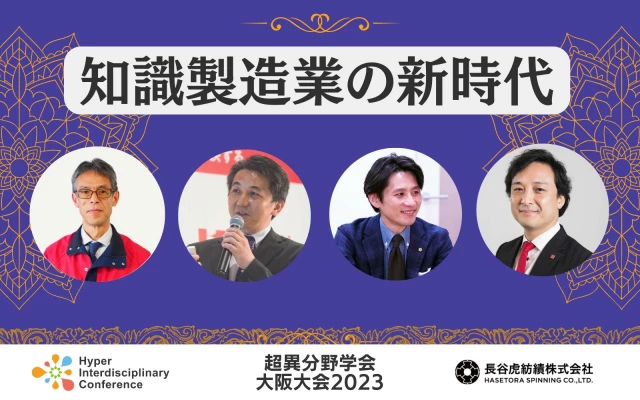
Hase Tora Spinning, a long-established spinning company founded in 1887, and Duskin, founded in 1963. Sixty years ago, the two companies joined forces to solve a challenge posed by Duskin’s founder—to “make cleaning easier”—and created an innovation that changed the world of housework. How was this collaboration—said to have begun with a chance encounter—actually made possible? And how will the “next innovation” in the textile industry come about? Mr. Kyōji Hase of Hase-Tora Spinning, Mr. Masahiro Imanishi of Duskin, and Mr. Tsutomu Ono of Full Area—a startup spun off from Okayama University—discuss the theme of “Knowledge-Based Manufacturing” (This article is a summary of the session “A New Era of Knowledge-Based Manufacturing” held at the Interdisciplinary Conference Osaka 2023).
Innovation is the result of solving problems.
RIVANES Yukihiro Maru The title of this session is"A New Era for the Knowledge-Based Manufacturing Industry"That's right. Are you familiar with the term "knowledge-based industry"?
Hase Tora Spinning Co., Ltd. — Mr. Koji Hase I suspect most people probably don't know what this is. It's a concept unique to Ribane, and it's also the title of Mr. Maru's new book.
suffix for names of swords, armour, musical instruments, etc. Thank you for that brilliant follow-up (laughs). You may be hearing the term “knowledge manufacturing” for the first time, but I’m sure everyone understands what “manufacturing” means. There isn’t a single person here right now who isn’t wearing clothes, and clothes are “manufactured goods.” The chairs we’re sitting on right now and this venue itself are no different—they’re all “manufactured” items. If you look at it from a slightly different perspective, even a long-established tofu shop that’s been in business for 100 years is a manufacturing business that produces tofu. In other words, everything around us—everything that reaches our hands—is thanks to the manufacturing industry. Furthermore, while 99.7% of Japanese companies are small and medium-sized enterprises, many of them are in the manufacturing sector. That’s why Japan is known as a nation of manufacturing.
Right now, Japan’s manufacturing industry is on the brink of crisis. If things continue as they are, Japan as a whole will decline along with the decline of its manufacturing sector. So, what should we do? In the coming era, we must invest knowledge in manufacturing to create new concepts. The book *The New Era of Knowledge-Based Manufacturing*, which Mr. Hase mentioned earlier, brings together that message and its specific details in a single volume.
lengthening a valley I am based in Hashima City, Gifu Prefecture, where our headquarters is locatedHase Tora Spinning CompanyI serve as the CEO of a company. As someone who is directly involved in a small-to-medium-sized manufacturing business, I was truly stunned when I heard Mr. Maru use the term “knowledge-based manufacturing.” To be honest, at first I thought “manufacturing” and “knowledge” were complete opposites. However, when I reexamined our company’s business from the perspective of “knowledge-based manufacturing,” I was able to identify strengths we hadn’t recognized before. And that enabled us to redefine the value of our business. I’d like to talk about that today.
suffix for names of swords, armour, musical instruments, etc. Actually, in my view, “knowledge manufacturing” is something that has long been practiced in Japan. I’ll go into more detail later, but what Duskin—where Mr. Imanishi, a speaker in this session, works—and Hase Tora Spinning did 60 years ago is, in my opinion, a prime example of knowledge manufacturing.
Masahiro Imanishi of Duskin That’s certainly true. Ever since our company was founded 60 years ago, we’ve been greatly indebted to Hase Tora Spinning.
suffix for names of swords, armour, musical instruments, etc. I also believe that Mr. Ono—another speaker at the event, a professor at Okayama University and CEO of Full Area, a university-spinoff startup—will be able to help build the “next generation of knowledge-based manufacturing” together with Hase Tora Spinning and Duskin.
Okayama University / Full Area: Tsutomu Ono Unlike the long-established Hase Tora Spinning and Duskin, I’m just a “newbie” in my first year of business, but I look forward to working with you all.
suffix for names of swords, armour, musical instruments, etc. The four of us will be discussing this topic today, but first, I’d like to briefly explain what “knowledge manufacturing” is.
First, as a general rule, the knowledge-based manufacturing industry does not begin with technology. It is not driven by technology alone. Rather, it starts with a specific challenge, and we then develop an approach to address that challenge. Without a challenge, a new manufacturing industry cannot begin.
And this issue, too, must be a “deep issue”—not just a superficial one that everyone is already familiar with. For example, diabetes is an issue. The global environment is also an issue. Everyone knows about these. But rather than stopping at that level of understanding, you must dig deeper and deeper, starting from a personal curiosity—asking, “What does this really mean?”—until you reach a specific point where you realize, “So this is where the issue lies!” That is what a “deep issue” is.
If we can identify the core issue, we can combine technologies to solve it. For example, to solve diabetes using tofu, we can’t rely on tofu as it is today; we need to create a collection of technologies by incorporating specific functionalities—such as this one or that one. This collection of technologies is, in essence, “new knowledge.” In other words, the knowledge manufacturing industry is about combining existing knowledge to create new knowledge in order to solve unresolved challenges.
Another important point is that solving problems requires “something tangible.” Today’s event is an interdisciplinary conference bringing together many researchers. What researchers do is make “discoveries.” However, discoveries alone do not qualify for patents. To obtain a patent, a discovery must be transformed into a reproducible “invention.” Once a discovery is turned into an invention and patented, it becomes what is known as “intellectual property.”
So, does having intellectual property change the world? Unfortunately, it does not. This is a major challenge, but Japan is overflowing with “unused patents.” There are discoveries, there are inventions, and there is intellectual property. However, since these assets aren’t being utilized, innovation doesn’t happen. This is because innovation arises as a result of solving problems. And to solve problems, we must combine knowledge and give it “form.” In other words, to drive innovation, the manufacturing sector is absolutely essential in the final phase. First and foremost, I hope that both researchers and manufacturers will fully understand this point.

Why a “98% Drop from Peak Levels” Is an Opportunity for Hase Tora Spinning
suffix for names of swords, armour, musical instruments, etc. Now, I’d like to pass the baton to Mr. Hase.
lengthening a valley Once again, this is Hase. First, let me explain the current state of the textile industry. Compared to its peak, more than 98% of Japan’s textile production capacity has been lost to overseas markets. In short, the number of companies operating in the textile industry in Japan has fallen to less than 2% of what it was at its peak. Given these challenging circumstances, how have we been able to continue our business? What are our strengths, and how can we make them even stronger? That is what I would like to discuss today.

lengthening a valley Hase Tora Spinning was founded in 1887 (Meiji 20). For the past 136 years, we have been engaged in the textile industry. However, our founder was not originally an expert in textiles, nor had he ever worked for a textile company. So why did he start a spinning company? It was to solve a social problem.
It is said that 136 years ago, Hashima City was a poor region with no industry to speak of. Many people worked in agriculture while also engaging in sericulture, barely making ends meet by selling their cocoons. However, these cocoons were bought up at rock-bottom prices by middlemen from the cities. As a result, children other than the eldest son—who was expected to take over the family farm—had to leave the area to find work elsewhere in their mid-teens. Consequently, the region never managed to become prosperous. Determined to break this vicious cycle, the founder decided to establish a silk-spinning company that would operate locally.
We purchase the cocoons that local people have raised with all their heart and soul at a fair price, while also providing them with jobs at our factory. If we can process these cocoons into raw silk locally, we add value to the product, which in turn enriches the entire region. Hase Tora Spinning was founded to make this vision a reality. I believe it is precisely because we have continually sought ways to contribute to society through our business that we have been able to build a history spanning 136 years.
suffix for names of swords, armour, musical instruments, etc. That's wonderful. However, even a company like Hase Tora Spinning must still be facing the same crisis as the Japanese textile industry as a whole.
lengthening a valley You're absolutely right. In this competitive society, manufacturing bases have been steadily moving to areas with lower labor costs. However, it's also true that the coming era holds tremendous opportunities.
Currently, global consumption of textile materials totals more than 90 million metric tons annually. Moreover, this consumption has doubled over the past 20 years. This is because clothing consumption has increased in proportion to population growth. As the world’s population continues to grow, this figure will continue to rise.
So, what would happen if Hase Tora Spinning were able to produce “environmentally friendly materials” in such an era? An opportunity will surely arise for our manufacturing to take flight on the global stage. In fact, Hase Tora Spinning has set a goal to “switch at least 80% of our products to eco-friendly materials by 2030.” We are truly committed to changing the world through textiles.
As part of our efforts to achieve our goals, we have been collaborating since 2014 with Spiber, a company that manufactures the synthetic protein material Brewed Protein™. In addition, various new fibers are being developed right here in Japan. By combining these fibers with our manufacturing expertise, we hope to contribute to society in new and innovative ways. That is our goal.
To put it simply, textiles are the products that are closest to people. They are in contact with our skin virtually 24 hours a day, 365 days a year. Their value is truly immense, and the potential for new initiatives in this area is immeasurable.
suffix for names of swords, armour, musical instruments, etc. If you look only at Japan, all you see is decline, but the moment you shift your perspective to the global stage, you realize there are huge opportunities. Furthermore, while it might seem like a negative to say, “Only 2% remains of Japan’s textile facilities from their heyday,” for the 2% that still exist today, it also means they can proudly declare, “We’re the only ones in Japan who can do this!”
lengthening a valley That's exactly right. The current situation in Japan is, in fact, an opportunity.

Duskin started out as a startup that rented out cleaning rags.
suffix for names of swords, armour, musical instruments, etc. Well, in this session, Hase Tora Spinning and Duskin are both taking the stage. Personally, I think today is a legendary day.
lengthening a valley This is the first time Duskin and our company have appeared together in the same session to present to an external audience, isn't it?
suffix for names of swords, armour, musical instruments, etc. As I briefly mentioned at the beginning, Hase Tora Spinning and Duskin have had a very long and deep relationship. To start with,DuskinMr. Imanishi, please tell us a little about your company.
Imanishi First, let me tell you about three key features of our company.
First, it is the first company in Japan to have launched a franchise business. Broadly speaking, it operates a total of 15 businesses across two main areas: a door-to-door sales group focused on cleaning and hygiene products, and a food group. The food group includes Mister Donut, which I’m sure you’re all familiar with. The company is also expanding overseas, primarily in Southeast Asia.
This year marks our 60th anniversary, and our very first product—the “Home DUSKIN,” a chemical cleaning cloth that removes dust without the need for water—was launched at the time of our founding. I’ll go into more detail later, but Hase Tora Spinning Co., Ltd. developed this Home DUSKIN for us.
Our second characteristic is that all of our businesses are face-to-face service industries. In our core cleaning service business—which centers on the rental of mops and mats—we work with 1,800 franchisees nationwide to deliver products to approximately 5.2 million households across Japan. Although Duskin is often perceived as a large corporation, we actually view ourselves as a collective of small and medium-sized enterprises.
The third characteristic is that the concept of “management through prayer” is at the core of the company’s operations. This is also the philosophy that Seiichi Suzuki, the founder of Duskin, pursued throughout his life. Having endured a difficult childhood marked by extreme poverty, Suzuki rose to prominence at a certain company and eventually married the daughter of its owner. However, this success drew the envy of those around him, which ultimately took a toll on his health and led to him contracting tuberculosis. It was during his hospitalization that he encountered *A Life of Repentance*, a book by Tenka Nishida that was a bestseller at the time. Deeply moved by its ideas, Suzuki subsequently joined Ittōen, the community founded by Nishida, and after undergoing spiritual training, arrived at the concept of “Management Through Prayer.”
Duskin continues to cherish and uphold this philosophy as its management principle to this day, and both our employees and franchisees must, just like Suzuki, undergo spiritual training—such as begging for alms—at Ittōen before they can become full members of the company.

Imanishi The specific details of that management philosophy are outlined in the image below. One of the points mentioned there is, “When faced with a choice between gain and loss, choose the path of loss.” I believe this aligns perfectly with the idea expressed in *The Knowledge Manufacturing Industry*: “Solve problems first; revenue will follow.”

suffix for names of swords, armour, musical instruments, etc. Thank you. Now, let's get down to business. Could you tell me about the relationship between Duskin and Hase Tora Spinning?
Imanishi We have been deeply indebted to Hase Tora Spinning Co., Ltd. ever since our company was founded. They formed a strong partnership with us in the development of “Home Duskin,” a household chemical cleaning cloth that became a hit in 1964. Since then, they have continued to provide us with materials incorporating new technologies for a wide variety of product developments, including our current flagship product, the red mop.
suffix for names of swords, armour, musical instruments, etc. I see. So, in a sense, it was as if Haseko Spinning—a more established company—supported Duskin, which was a startup 60 years ago. How did the two companies first come into contact?
lengthening a valley It all began when my grandfather—who was the company president at the time—happened to pass by and saw Seiichi Suzuki, the founder of Duskin, bowing his head in prayer before our silkworm memorial. Noticing a stranger, my grandfather spoke to him, and Mr. Suzuki replied, “Actually, I came here to request the development of a new type of thread, but my request was turned down. Still, I’m grateful just to have been able to come here. So, I was paying my respects before returning to Osaka.” This was in 1963, so there was no Shinkansen yet. In other words, he had taken a conventional train from Osaka to Gifu—a journey that took several hours—and was expressing his gratitude even though his request had been turned down. My grandfather, thinking, “What an unusual man,” asked, “What is this thread for?” Mr. Suzuki reportedly replied, “I want to start a cleaning cloth rental business for the happiness of the world. I’m looking for the right thread to make it happen.”
Everyone, please think about this for a moment. Sixty years ago, if someone had pitched a business idea involving renting out cleaning rags, most people wouldn’t have agreed to help. In fact, our company’s representative initially turned him down, saying, “That’s not something we can do.” However, my grandfather was deeply moved by Mr. Suzuki’s passion. So he called that representative and an executive back in, and the four of them—including Mr. Suzuki— “You were right to turn it down. I don’t know if this business will succeed either. But after hearing Mr. Suzuki’s passion, I really want to help,” he said, persuading them.
suffix for names of swords, armour, musical instruments, etc. Sorry to interrupt. Why was Mr. Suzuki, the founder of Duskin, so particular about cleaning rags?
Imanishi The background to this is that Suzuki had originally worked in the waxing business, so he had the know-how to bring out a shine. At the same time, he came across a dust control technology—originally developed in the United States—that removes dust without using water, and he was reportedly so impressed that he exclaimed, “What a wonderful product—a ‘chemical cloth’ that gets itself dirty to make others clean!”
lengthening a valley What really moved me was the story of how the cleaning cloth led to women’s entry into the workforce. Back in the 1960s, even in winter, people would wring out cleaning cloths with cold water, and their hands would quickly become chapped. It seems Ms. Suzuki had a vision: “I want to make cleaning and other household chores easier with a cleaning cloth that doesn’t require water.”
suffix for names of swords, armour, musical instruments, etc. I see. So, in other words, the founder of Duskin had a problem he was determined to solve.
lengthening a valley Yes. That’s exactly why my grandfather trusted Mr. Suzuki after just a brief encounter, and why he personally bowed his head to the employee who had initially turned down the offer, asking him to rejoin the project. In a sense, I feel that Duskin’s innovation began with that moment of trust.
suffix for names of swords, armour, musical instruments, etc. You’re absolutely right. Innovation cannot emerge without serendipitous encounters. And those encounters can only turn into projects when there is mutual trust—the belief that “we want to solve this challenge together.” “Can I trust this person?” “Could this work against me?” “Is there really any benefit for me?”—new initiatives simply won’t get off the ground if driven by such competitive thinking. Not mere confidence, but trust. Not competition, but symbiosis. I believe the 60-year history of symbiotic innovation between Hase Tora Spinning and Duskin proves the validity of this philosophy.
In the Age of Sustainability, Spinning Technology Is Taking a Step Back
suffix for names of swords, armour, musical instruments, etc. Now, it’s time to put “knowledge manufacturing” into practice in public. As a professor in the Division of Environmental, Life, and Natural Sciences at the Graduate School of Academic Research, Okayama University, andFull Area, Inc.Mr. Tsutomu Ono, our representative—thank you for waiting so long. Let’s see if Hase Tora Spinning and Duskin can combine their new, comprehensive knowledge to launch the next generation of the knowledge-based manufacturing industry. First, Mr. Ono, please introduce your company’s technology.
Ono Thank you for your attention. First, let me give you an overview of our company. Our company name, “Full Area,” embodies the concept of “Fluere (fluid) to Material (material).” Our business is based on the concept of using microchannels to precisely control fluids, thereby providing unprecedented functional materials and manufacturing methods for those materials.

Ono Our base in Okayama, like Gifu—home to Hase Tora Spinning—is a textile town. However, as times changed, the precision metalworking technology used to manufacture spinning nozzles—which are essential for the production of synthetic fibers—was gradually losing its purpose. The starting point for our business was the idea of finding a way to apply that technology to chemical processes.
Technically, the core of this technology is wet spinning using microchannels. To explain this in a bit more detail, the process involves creating two flows—an inner and an outer flow—within a small nozzle; the outer flow squeezes the inner fluid, and as it is drawn out, it solidifies to form a fiber. While wet spinning is a long-established technology, our company’s strength lies in the use of microchannels, which, combined with the action of the outer flow, enables us to produce extremely fine fibers.
Most synthetic fibers are produced using a process called dry spinning, in which petroleum-derived materials are melted at high temperatures, drawn into filaments, and then solidified. Since this process is well-suited for mass production, it is the method used by almost all major companies, and as a result, there are now very few companies that still use wet spinning.
However, most of the natural, sustainable fiber materials that will be absolutely essential in the years to come are sensitive to heat. In other words, they are not suitable for dry spinning. What is needed now is wet spinning technology, which involves solidifying the fiber within a flowing solution to form the fiber. Therefore, we aim to significantly advance our wet spinning capabilities and tap into new markets while fully leveraging Japan’s advanced technology.
To achieve this, we face two major challenges. The first is a lack of advanced processing technologies for manufacturing. The second is that the apparel industry—the primary application for these fibers—does not currently require fibers of this level of fineness. In other words, we must identify new applications for these ultra-fine fibers moving forward. We are currently seeking partners to help us build this business together. If you are interested, please feel free to reach out to us.

"This fiber should be able to solve my problem."
suffix for names of swords, armour, musical instruments, etc. Now that we’ve heard Mr. Ono’s presentation, let’s think about the potential applications of this technology. Mr. Imanishi from Duskin must be well aware of consumers’ feedback and the challenges faced on the front lines. What do you think?
Imanishi First, if we consider our products that use nanofibers, masks and air purifier filters come to mind.
suffix for names of swords, armour, musical instruments, etc. Still, it seems like it might be a bit pricey for that purpose, doesn't it?
Imanishi That's true. I suppose it depends on the scale of mass production, though.
suffix for names of swords, armour, musical instruments, etc. Mr. Ono, if we can start mass production, will we be able to lower the price?
Ono If we make capital investments and achieve economies of scale, prices will go down. However, the current reality is that it seems unlikely there would be enough demand to justify producing such large quantities. For example, if masks were made from ultra-fine fibers, air resistance would be significantly reduced, so it should be possible to create high-performance masks that address the issue of breathability. Ultimately, though, I think they’ll lose out to cheaper materials like ordinary nonwoven fabric because people will conclude, “We don’t need that level of performance.”

suffix for names of swords, armour, musical instruments, etc. Mr. Hase, do you have any good ideas?
lengthening a valley I think clarifying what kinds of effects can be achieved through nanotechnology is an important process. For example, precisely because the fibers are ultra-fine, they offer high thermal insulation or excellent sound absorption. If we can clearly identify these effects, I believe the direction for product development will become clearer.
suffix for names of swords, armour, musical instruments, etc. I see. But looking back on today’s discussion, the founder of Duskin sought out Hase-Tora Spinning because he had a specific challenge in mind, right? Specifically, what kind of challenge was he facing, and what was he looking for when he visited Hase-Tora Spinning?
Imanishi With “Home Duskin,” both the warp and weft threads differ in both their spinning methods and thickness. This requires technology specifically suited for dust-control cloths. Furthermore, since Home Duskin is not a disposable product but one designed to be used repeatedly, it must be durable enough to withstand repeated use for five or even ten years. Whether it’s the first time or the 100th time it’s used, it must maintain the same appearance every time.
suffix for names of swords, armour, musical instruments, etc. Mr. Suzuki, the founder, was so eager to create this “new cleaning cloth” that he traveled all the way from Osaka to Gifu, convinced that Hase Tora Spinning must have the technology to make it happen and solve the problem.
Imanishi Yes, that's right.
suffix for names of swords, armour, musical instruments, etc. In that case, the key really is to start with the problem. Rather than asking, “What can this technology be used for?” the correct approach is to ask, “Could these ultra-fine fibers help me solve the problem I’m trying to tackle?”
lengthening a valley That's certainly true.
suffix for names of swords, armour, musical instruments, etc. It seems difficult to come up with an answer right now, but let's keep trying.
Ono I would very much like to collaborate with a company to achieve what our esteemed predecessors, Hase Tora Spinning and Duskin, accomplished 60 years ago.
suffix for names of swords, armour, musical instruments, etc. That’s right. I’d love to hear that story 60 years from now.
Ono Yeah, if I'm still alive, I'd love to (lol).
suffix for names of swords, armour, musical instruments, etc. Time has flown by, and we’ve already reached the end of our session. But let’s all—small and medium-sized businesses, startups, large corporations, universities, the current generation, and the next—come together to shape the future through the “knowledge-based industry”! Thank you all very much for joining us today.


![KOBASHI Group] Evolution of Local Small and Medium-Sized Enterprises Caused by the Shift to Knowledge Manufacturing / Creating Businesses Like Startups While Being a 100-Year-Old Company (President x Next Generation Dialogue)](https://km.lne.st/wp-content/uploads/sites/81/2024/03/kobashi_tatsuzaki_top-1024x683.jpg)