- Speech/Session Reports
From the Theory of Talent to the Theory of Design: What Makes an Organization That Continuously Generates New Businesses?
2026.05.07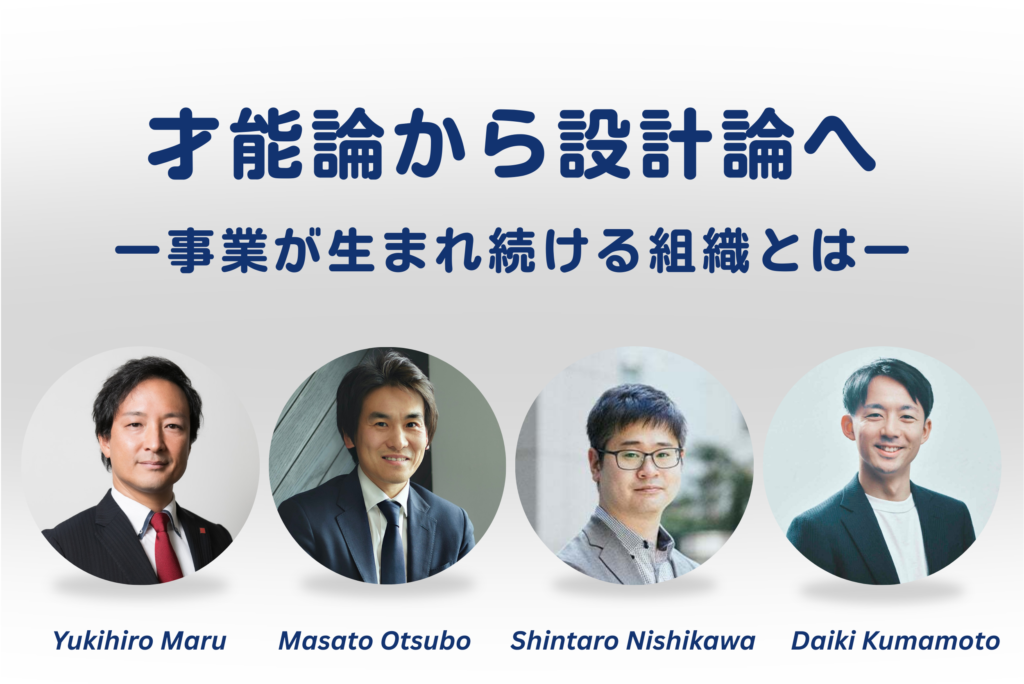
When faced with launching a new business, many organizations grapple with the same question: Is it ultimately individuals with “special talent” who create new businesses? Or is there a “blueprint” that can be replicated by the organization as a whole?
In this session, focusing on the practical experiences of Masato Otsubo, President and CEO of Yuki Holdings—a company that has expanded its business from small local factories into the fields of space, healthcare, and superconductivity—Senior Director Shintaro Nishikawa of Japan Tobacco Inc.’s Corporate R&D “D-LAB,” Shintaro Nishikawa, Senior Director at Japan Tobacco Inc.’s Corporate R&D “D-LAB”; Daiki Kumamoto, Director and CEO of UntroD Capital Asia Pte. Ltd.; and Yukihiro Maru, Representative Director and Group CEO of Lifeness, engaged in a discussion from their respective perspectives.
What exactly does “talent” refer to?
Maru: Today’s session is titled “From the Theory of Talent to the Theory of Design.” To begin with, is launching a new business a matter of “talent” or “design”? It’s a long-standing debate, isn’t it? First, I’d like to hear what Mr. Otsubo has to say and consider whether this was achieved because of talent, or if there are logical insights that emerge from the process. That’s what I’d like to explore.
Otsubo: I was born as the third-generation owner of Otsubo Rashi Manufacturing, a small local factory that made screws. We used to manufacture parts for public pay phones, but when that business dried up, the company was on the verge of bankruptcy. Determined to turn the business around, I left the startup where I was working at the time and returned to the family business. But when I got back, there was nothing for me to do. There was no future in just making screws. So, when I thought about where screws are used, it occurred to me that they could be used in aviation and space. That’s when I decided to enter the aerospace industry. From there, we’ve expanded our business—centered on precision machining—to include satellite components, joint development projects with JAXA, small recovery capsules for bringing supplies back from space, spinal implants, watches, audio equipment, and now even superconductors.
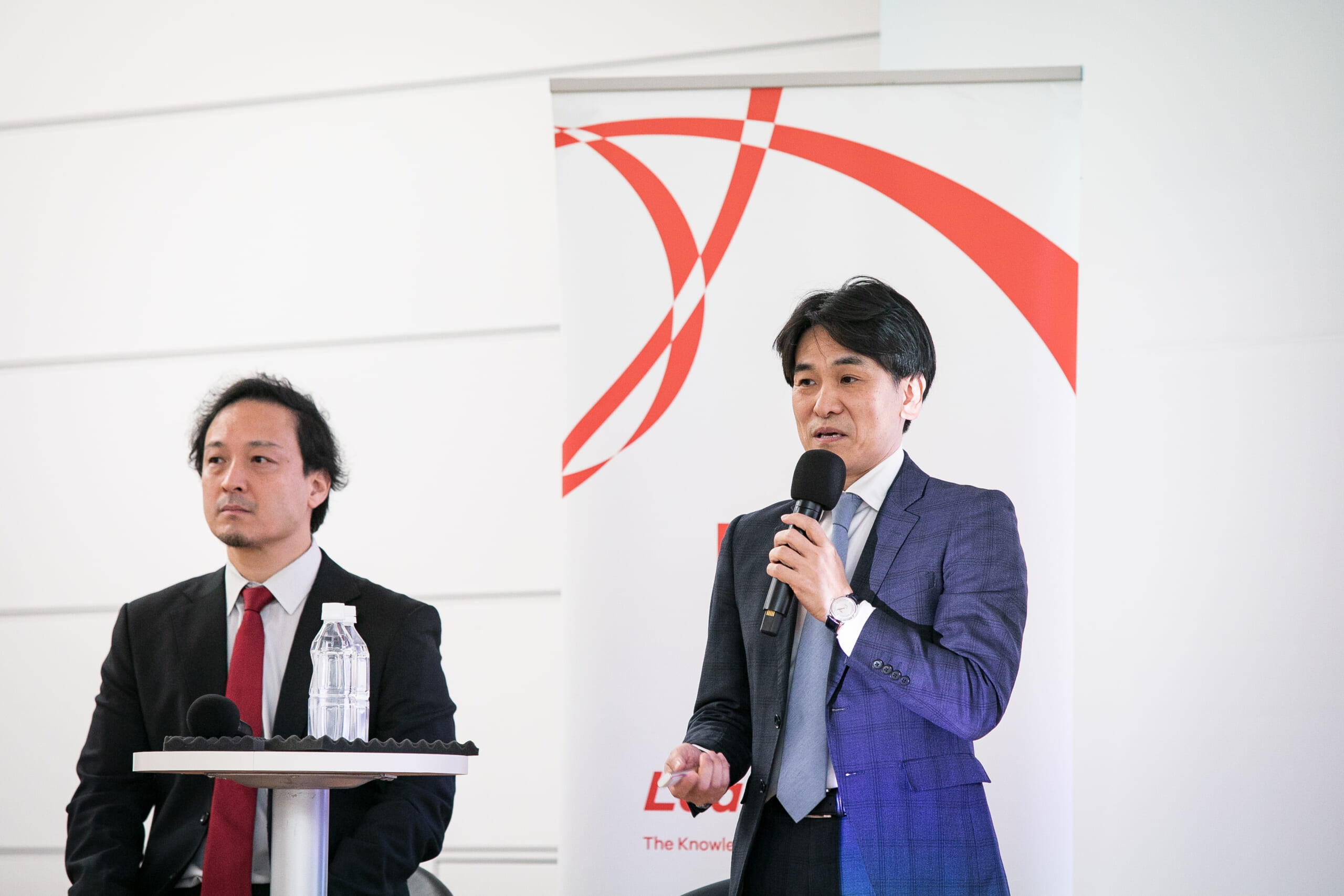
Nishikawa: It’s exactly as a passage from Sun Tzu’s *The Art of War* says: “In battle, one engages the enemy with orthodoxy and wins with the unexpected.” We have the “orthodoxy” of precision machining as our foundation. Building on that, we’re employing “the unexpected”—venturing into areas like watches, audio equipment, and superconductivity—that most companies wouldn’t normally pursue. I suspect that without that “unexpected” element, our next challenges wouldn’t have emerged.
Maru: I see. So how did that “strangeness” come about? Did someone give you a nudge, or did it just come naturally?
Otsubo: The aerospace and medical fields I mentioned earlier are relatively serious lines of business. When I calmly considered where mechanical parts are used, I figured these areas would likely remain viable. On the other hand, watches and audio equipment are quite hobby-oriented. They stem from my own hobbies or the passion of our head of development. Take the audio player, for example—our head of development had been secretly working on it for a whole year. One day, he brought me a proof-of-concept prototype and said, “Mr. Otsubo, I’ve finished this. Can I turn it into a product?” When I saw it, I thought, “This is interesting,” and decided to commercialize it without hesitation.
Nishikawa: So, what you’re saying is that employees who truly understood our assets were thinking about where our proprietary technology could be applied. And management recognized that. I think this isn’t just a matter of talent—it’s something that can be engineered.
Talent may be less about genius and more about the "ability to fall forward."
Maru: I’d like to take a moment here to define what “talent” actually is. Everyone says “he has talent” so casually, but what exactly are they basing that on? So, Mr. Kumamoto and Mr. Otsubo, do you two have talent?
Kumamoto: I think so. At least, based on what I’ve seen, there aren’t many examples of third-generation owners of small local factories bringing in new technology and securing outside funding to create the next industry. I think the people who can make that happen are exceptional and talented.
Maru: Mr. Otsubo, do you think you’re talented?
Otsubo: I don’t think I can sum up my talent in a single word, but what I’m good at is something like “trying things without thinking they’re impossible.”
Maru: That's what they call "numbness," isn't it? (laughs).
Otsubo: That's right. I guess you could say I'm a bit numb to fear.
Nishikawa: I have two thoughts on talent. First, innovation is all about combinations. The more unexpected those combinations are, the more interesting they become. Second, it’s about having a unique perspective on risk. They’re able to take the plunge even in situations where most people would think, “I wouldn’t spend money that way.”
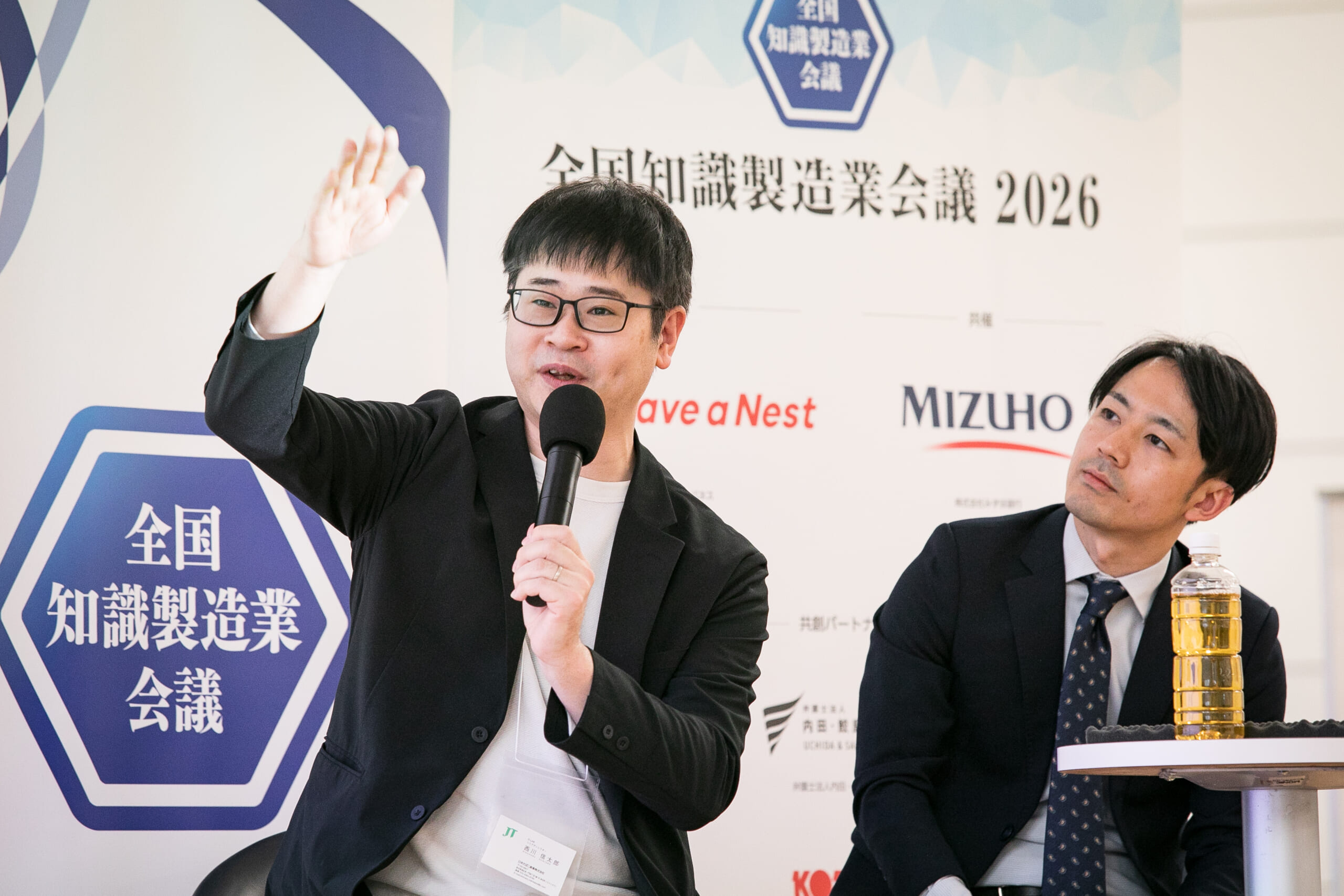
Otsubo: That might be true. When I joined Yuki Seimitsu, the company had no cash, I wasn’t even getting a salary, and we didn’t know when we might go under—that’s the kind of situation it was. But it was precisely because of that situation that I thought, “Let’s spend it.” Normally, you wouldn’t spend money like that, right? But I felt that if we didn’t, the company would definitely not survive. Of course, it wasn’t a waste of money. I’ve provided a personal guarantee, and I have to protect my family. I’m acutely aware of the risks. But even in that situation, if you don’t invest properly, you won’t be able to recoup your investment. In a way, that’s part of the training, too.
Maru: Oh, training, huh?
Otsubo: Yes. I started my business when I was 31, and now that I’m in my 50s, I’ve been doing the same thing over and over for nearly 20 years. So, rather than calling it talent, it feels more like I’ve been training myself to fall forward.
Kumamoto: What’s more, talented people don’t feel like they’re “fighting alone.” There are always people who admire their talent and want to support them. I think that’s incredibly important, too.
Don't just find a market—create one
Maru: What I find interesting here is that I think Mr. Otsubo has two sides to him. There’s the side of him as the third-generation owner of a small local factory who has transformed the existing business, and the side of him as an entrepreneur who is now betting on areas like superconductivity—where there isn’t yet a market. Are these two sides the same?
Otsubo: I don’t really think of them as separate things. I’m not very versatile. Even when I was running Yuki Seimitsu, my mindset was, “Let’s leverage our strengths and do something completely different from what we’ve done before.” If the products we manufacture aren’t selling, I ask myself why. If it’s because there’s no market for them, then I figure, “Let’s create one ourselves.”
Kumamoto: But from an investor’s perspective, the market is still important, isn’t it? On the other hand, I don’t think this is necessarily a world where “ideas with potential but no demand” are doomed to fail. There are various platforms that support the passion of individuals, and sometimes those ideas survive and eventually flourish somewhere. While there are limits to what VCs can invest in, that isn’t the only answer.
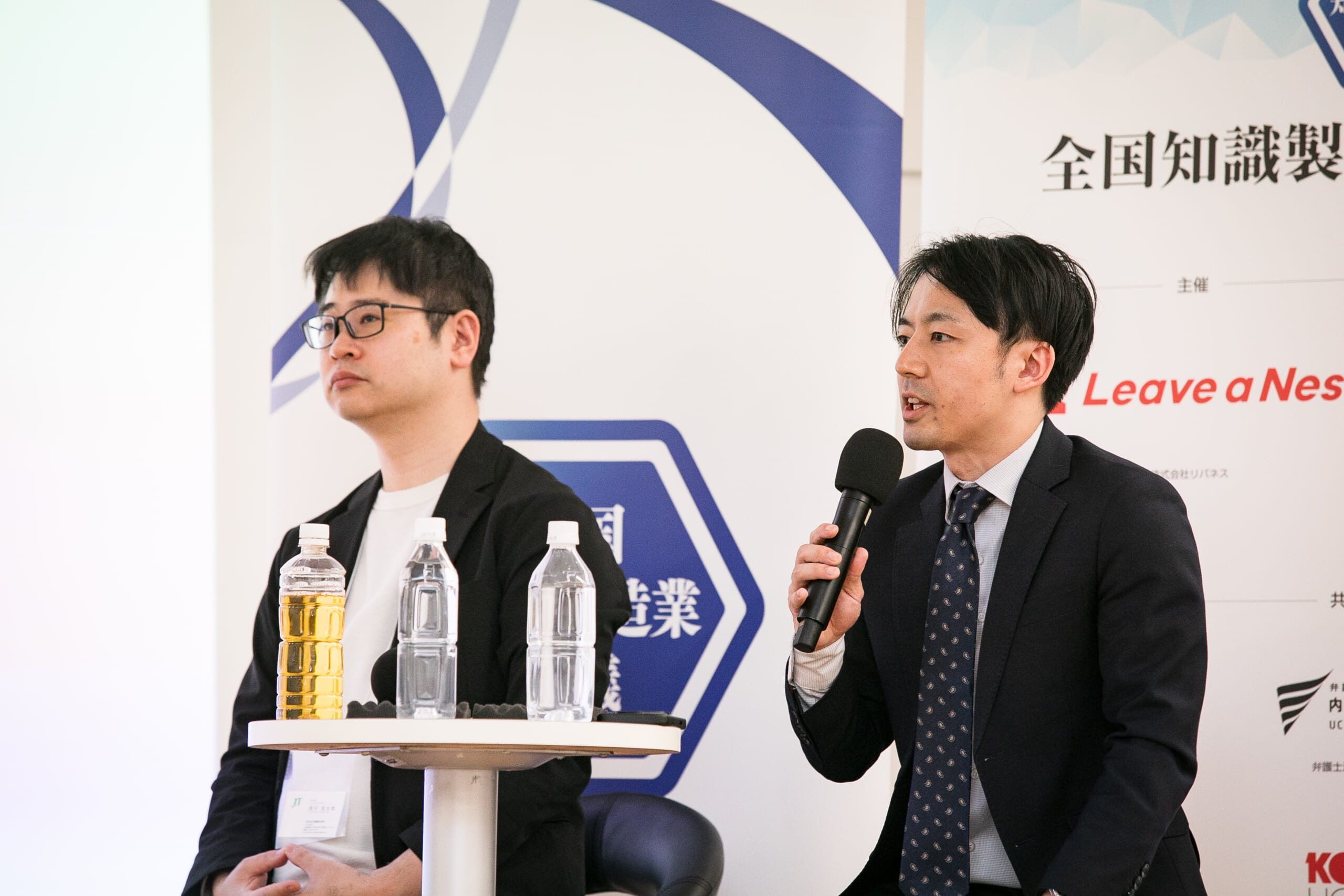
Otsubo: Personally, I find it more fun to create markets. Take the space debris cleanup project at Astroscale—a company I’ve been helping since before it was founded—there wasn’t a market for that from the start. The same goes for superconductivity. Although the market is limited right now, wouldn’t anyone agree that a wire with zero electrical resistance is appealing? If that’s the case, we should just create a new market from there. I’ve been thinking about what form would be easiest to scale, and right now I’m working on creating “the most user-friendly superconducting wire.”
Nishikawa: That’s the key point, isn’t it? The 20th century was the age of oil, and the 21st century has become the age of computing resources. Within that context, it’s quite clear what will become the bottleneck. The reason a global battle for semiconductor supremacy is unfolding is precisely because people can see the “computing resource constraints” that lie ahead. In response to that, certain individuals can already see the next domino falling. Perhaps that’s one of the hallmarks of true talent.
Can an Entrepreneurial Mindset Be Developed?
Maru: I’d like to ask Mr. Nishikawa about this. Right now, Ribane and JT are working on “D-0."We're working together on a program called 'D-0.,' right? Where does this 'D-0.' fit in?"
Nishikawa: JT is a company whose tobacco business accounts for 90% or more, but achieving long-term sustainability is difficult to achieve through that alone. That’s why JT has a corporate R&D organization called “D-LAB (Delightful Momento Laboratory)” that explores opportunities outside the tobacco business from a long-term perspective. We’ve been working with Ribane for quite some time now, and at first, we didn’t really understand what “startups” or “new businesses” were all about. That’s why we felt it was important to first become part of the ecosystem. Identifying technological seeds, providing seed funding, offering workspace, and connecting them to further investment—I thought it would be best to integrate all of these elements. That’s the concept behind “D-0.”
Maru: In other words, you’re integrating the support functions that used to exist in isolation into a single, end-to-end system.
Nishikawa: That’s right. What I consider particularly important is the entrepreneur’s mindset. It’s not what happens after a product is launched that matters—it’s the mindset you have before that. We identify, nurture, and provide hands-on support. I believe the chances of success are higher if we help them evolve from scratch. That’s the hypothesis I’m working with right now.
Kumamoto: But that’s something I’m really interested in. I wonder if that kind of mindset can even be engineered in the first place. When we look at entrepreneurs, we often examine “what drives them forward.” Do they have a formative experience? Does the problem they want to solve come from within? That inner drive really plays a major role. So, whether that can be replicated through a program is a pretty big question, isn’t it?
Nishikawa: To put it simply, wouldn't it be better to ask the questions you'll be asking at the Investment Committee meeting in advance during the "D-0" session?
Kumamoto: I see. I’ll just ask right from the start.
Nishikawa: That’s right. Instead of suddenly asking questions like, “Can’t we think bigger?” or “What kind of market lies ahead?” at the investment stage, we keep asking them from the very beginning. However, the key is not to grill them, but to grapple with these issues together. That’s probably what we should be doing. My underlying concern is that, in reality, the ultimate support system doesn’t actually exist yet.
Shouldn't we be designing ecosystems rather than individuals?
Maru: So, in other words, it’s not about designing the individual themselves, but rather designing an environment where that person can thrive, right?
Nishikawa: I think there are limits to what an individual can plan. If you have 30 million or 50 million yen right in front of you, making decisions that could potentially squander that money requires a certain level of personal resilience. But if there’s one thing that can be planned, I think it’s the ecosystem. Japan surely has its own way of doing things, and I believe one of those ways is collaboration centered on knowledge.
Maru: Mr. Otsubo, are you considering that kind of design within the company as well?
Otsubo: Right now, I’m actually thinking about whether we can systematize this as the “Yuki Method.” For example, how to disseminate information, how to approach M&A, and how to bridge technology with cutting-edge industries—things like that. Japanese small and medium-sized enterprises (SMEs), in particular, have built up tremendous assets over the past 50 years or so, whether in materials development or processing technologies. But there’s no one to connect those assets to the next generation or new markets. Large corporations can set up dedicated marketing and exploration teams. But small and medium-sized enterprises are already stretched thin just keeping up with production. That’s why I believe we need to find a way for these companies to leverage those external assets as a team.
Kumamoto: That’s a really important point. When you think about an organization that will last 100 or 150 years, talent alone isn’t enough. Even if the founder was a visionary who led the way, you still have to plan how to pass the torch to the second, third, and subsequent generations.
Otsubo: I believe Japan has the strength that comes from having built long-standing organizations. If we build on that foundation by “looking toward the world,” I’m sure we can continue to create new businesses.
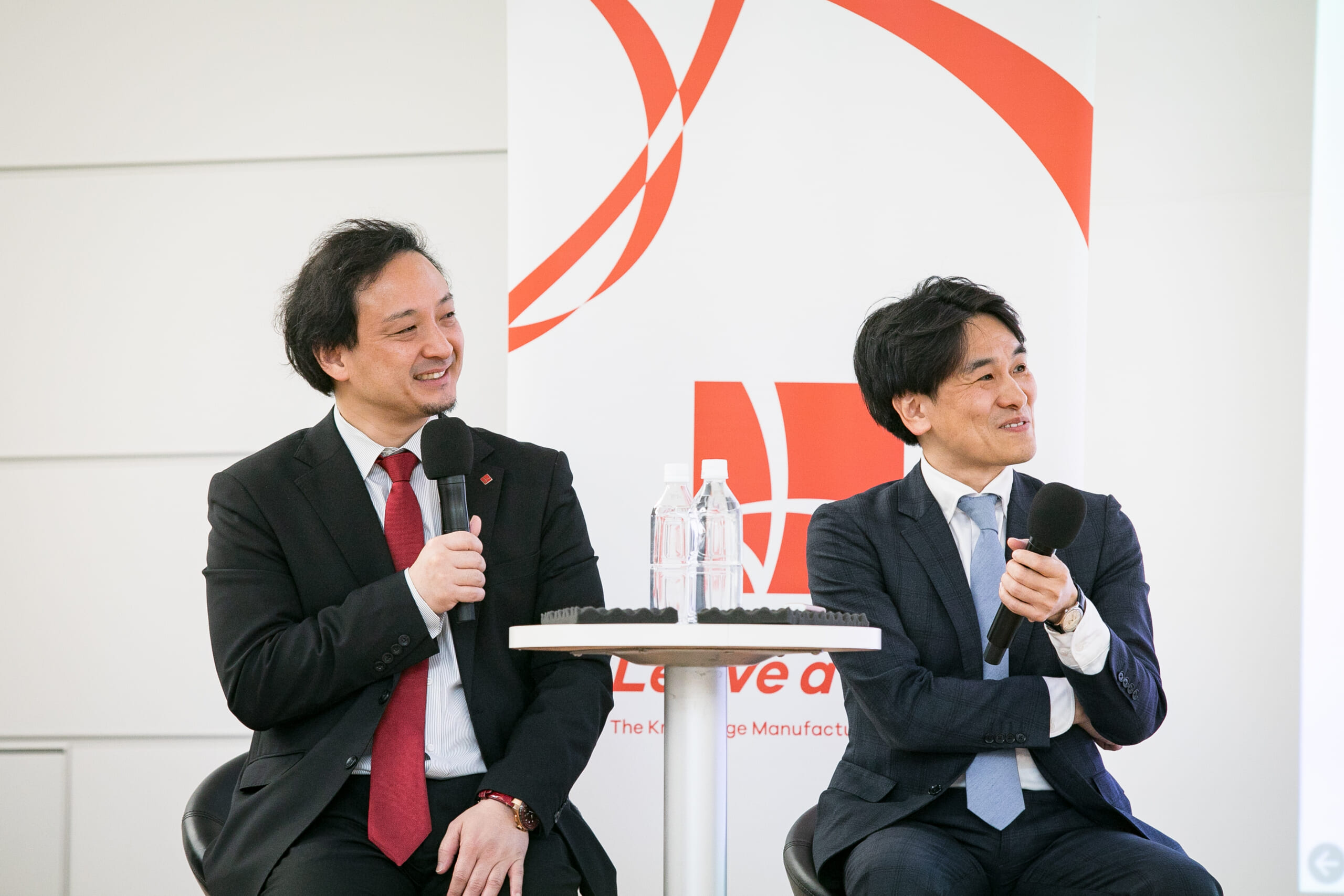
From the Theory of Talent to the Theory of Design: What Lies Ahead?
Kumamoto: The majority of businesses that have been in operation for 100 or 150 years originate in Japan. This country has a strength in designing structures that enable organizations to endure over the long term. Building on that foundation, we are turning our attention to the global stage. As a fund, we hope to support these efforts.
Nishikawa: Innovation and market creation don’t happen overnight. That’s precisely why I believe it’s important to work with our partners as equals and treat them with respect. What we can do, I suppose, is grapple with these challenges together.
Otsubo: When you’re completely immersed in the world of manufacturing, your perspective inevitably becomes narrow. I learned a great deal from the “National Conference on Knowledge-Based Manufacturing.” With the manufacturing industry currently undergoing major changes—such as the rise of AI—I actually believe this presents a tremendous opportunity. Let’s work hard together.
Maru: What has become clear from today’s discussion is that design confined solely within the company is not enough. If the “knowledge manufacturing industry” becomes an ecosystem for small and medium-sized enterprises, and we incorporate that into our internal design processes, it could create a system where new businesses continue to emerge. I believe there is potential there. It’s true that the ability to generate new businesses may lie in the exceptional talents of individuals. However, to ensure that such exceptional abilities do not end as mere “chance talents” but instead lead to the next challenge, design is essential. The phrase “from the theory of talent to the theory of design” is not meant to deny the existence of talent. Rather, it may be a declaration that we are now entering a stage where organizations must take on the responsibility of creating the conditions in which talent can thrive.
*This article is a summary of the panel session titled “From the Theory of Talent to the Theory of Design: What Makes an Organization That Continuously Generates New Businesses?” held at the National Knowledge-Based Manufacturing Conference 2026 on March 27, 2026.
We have also published a similar article on “L Media,” a media platform designed to accelerate “knowledge creation.”
![KOBASHI Group] Evolution of Local Small and Medium-Sized Enterprises Caused by the Shift to Knowledge Manufacturing / Creating Businesses Like Startups While Being a 100-Year-Old Company (President x Next Generation Dialogue)](https://km.lne.st/wp-content/uploads/sites/81/2024/03/kobashi_tatsuzaki_top-1024x683.jpg)