- Interviews
Three cases of successful employee awareness change through renewal of philosophy
2024.01.30
To foster cooperation among all employees and blaze a “new trail” as a manufacturing company, a renewal of our corporate philosophy is essential. In this article, we feature three executives who undertook the task of redefining their corporate philosophy and creating new businesses. We explore how this renewal of their corporate philosophy brought about changes in each individual employee, as well as how organizations should approach the kind of philosophy required for the coming era (based on content from the “Knowledge Seminar: Reexamining Corporate Philosophy in the Era of Individual Network Organizations,” hosted by Lifeness).
(1) The words I created to convey a message both inside and outside the company ended up changing me
/DG TAKANO
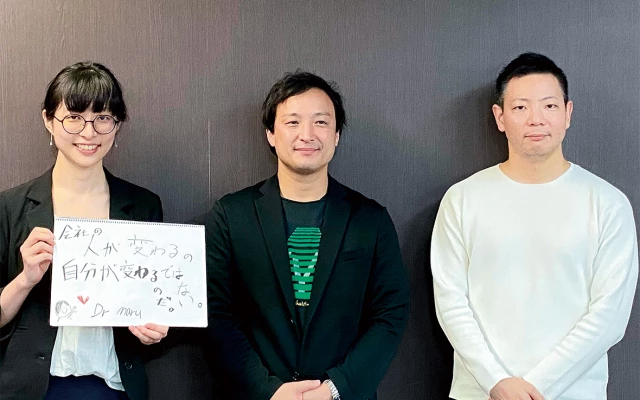
Masaaki Takano of DG TAKANO Co., Ltd. won the Manufacturing Excellence Award for developing the “Bubble 90” water-saving nozzle—which achieves water savings of up to 951 TP3T while delivering overwhelming cleaning power—and, as he rose to fame overnight, came to realize the necessity of a corporate philosophy. A Sense of Discomfort Arising from the Process of Creating a Hit Product: DG TAKANO is a company that traces its origins to “Designers Guild LLC,” which was founded by Mr. Takano.
“I believe that solving the world’s problems and helping people realize their dreams is the true essence of fulfilling work. What’s needed to make dreams come true is the power of design—the ability to grasp the essence of a problem and devise an approach to solve it.” With this belief, I founded a company dedicated to helping many people realize their dreams together. Our first project was the development of “Bubble 90,” a nozzle designed to tackle water shortages. This product was well-received by customers—particularly those in the food service industry—and achieved overwhelming success.
Around the time the business got off to a smooth start and the company changed its name to DG TAKANO Co., Ltd., Mr. Takano began to feel uncomfortable with the fact that his company was perceived as a “Bubble ’90s” firm. After voicing his thoughts repeatedly, a single phrase emerged. As he reflected on this sense of unease, he realized, “To grow beyond our current state, I need to communicate my original vision: designing a world where people’s dreams can come true.” It was only when his desire to “showcase the Designers Guild worldview both inside and outside the company and work together to create the future I envision” grew stronger that he realized a corporate philosophy was necessary. First, I simply poured out everything that was in my head. Through this cycle of expressing my thoughts and then rethinking them, I arrived at a single keyword that I found truly satisfying. That keyword is “Co-Creation.”
Not “coexistence,” but “harmony.” By lifting each other up and pooling our wisdom, we can create a world where we achieve our individual dreams while thriving together with the Earth. It was from this resolve that our philosophy—“Realizing harmony between people and the Earth through knowledge and innovation”—was born. It’s not the employees who change—it’s the president himself. “When I founded the company, I thought a corporate philosophy was just idealistic nonsense and unnecessary,” says Mr. Takano. What was the greatest value in creating this philosophy? “I created it to communicate the future I wanted to realize to people both inside and outside the company, but in the end, I was the one who changed the most,” he explains. Through the process of creating the philosophy, his own thoughts became organized, and the criteria for making decisions and the actions he needed to take to move toward the future became clear. As the president’s behavior changed, the job applicants who were drawn to the company because they resonated with his vision also began to change. Today, many talented employees have gathered under Mr. Takano’s leadership, working together on projects that realize both their own dreams and those of others.
(2) Employees are transformed by words that reflect their own aspirations as they identify with the legacy they have inherited
/Aokishintech
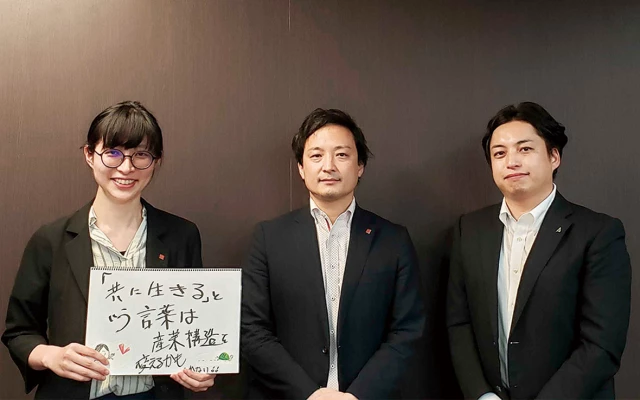
Aoki Seisakusho Co., Ltd., headquartered in Moka City, Tochigi Prefecture, changed its name to Aoki Syntech Co., Ltd. in March 2020 and revised its corporate philosophy. Building on the foundation inherited from its predecessors, the company made a major decision for the future. How did this new philosophy come about, and how is it transforming the organization?
The Need for a New Philosophy That Emerged After Exceeding 30 Employees Keita Aoki, Representative Director and CEO of Aoki Syntech Co., Ltd., joined the company 20 years ago, which his father had founded alongside his grandfather. At the time of his joining, the company had only five employees. Since then, the environment surrounding the manufacturing industry has changed dramatically. The role of manufacturing ordered products accurately, quickly, and inexpensively was taken over by overseas operations; manufacturing processes became increasingly specialized; and the division of labor among small and medium-sized enterprises (SMEs) advanced. Amid these circumstances, Mr. Aoki began to notice a weakening and distortion in the bonds between employees around the time the company’s headcount exceeded 30.
“Our philosophy at the time was ‘Bringing Imagination to Life Through Manufacturing Technology.’ Looking back now, I realize it was a philosophy designed for the people on the production floor. As our workforce grew and the number of employees not directly involved in manufacturing increased, I felt we needed a new philosophy as an organization.” As he revisited the company’s philosophy to give concrete form to “coexistence” and showcase it both internally and externally, Mr. Aoki placed great importance on his father’s original vision from the company’s founding. The company began its operations with a focus on automotive machinery, inspection, and repair, driven by the hope that “people would use things with care rather than simply discarding them.” Combining this with his own desire to “experience the joy of creating things with a variety of people,” the philosophy of “taking on the challenge of a symbiotic manufacturing industry” was born.
He expressed his determination to create a new manufacturing company that collaborates with all business sectors and takes post-use maintenance into account. And Mr. Aoki began to realize “coexistence” one initiative after another. He collaborated with I-Eat Co., Ltd., a venture spun off from the local Utsunomiya University, to develop an autonomous tracking robot, and launched a project with the AI venture Eco-Pork Co., Ltd. to develop livestock equipment and facilities. His activities expanded into fields such as food, agriculture, and healthcare, fostering collaborations with researchers and startups.
This new philosophy—along with Mr. Aoki’s actions—immediately changed employee behavior. Communication between departments improved, and opportunities for mutual support increased. Whereas before, no one would offer a helping hand even when a colleague was struggling with a task, it has now become common to see employees teaching one another, saying, “That’s what ‘co-creative manufacturing’ is all about.” Seeing the company where every employee is conscious of “coexistence” and uses the term almost like a catchphrase, Mr. Aoki now aims to cultivate leaders who will promote manufacturing based on the principle of “coexistence.” “Going forward, regardless of industry or position, we want to coexist with a diverse range of people and change the world by leveraging our strength in manufacturing,” he says. Aoki Syntech’s journey, guided by the banner of “coexistence”—a fusion of the founder’s vision and Mr. Aoki’s own—has only just begun.
(3) Redefinition Points the Way to the Next 100 Years
/KOBASHI HOLDINGS
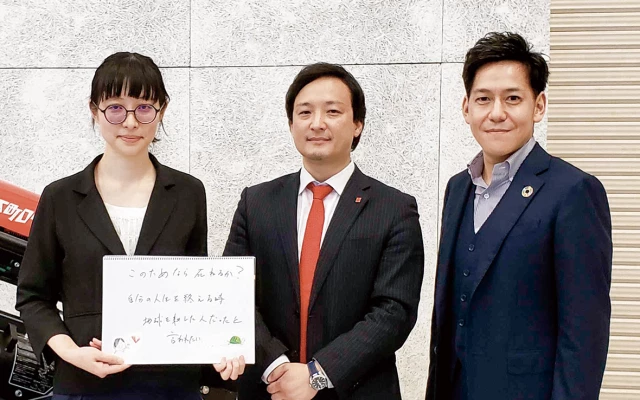
Kobashi Industry Co., Ltd., a group company of KOBASHI HOLDINGS Co., Ltd., is an agricultural machinery manufacturer founded in Okayama Prefecture in 1910. It boasts the top market share in Japan for its line of over 2,000 types of tiller tines. Masajiro Kobashi, who succeeded his father as the fourth-generation president in 2016, redefined the company’s traditional philosophy with an eye toward the future and established a new vision for the next era. What matters most is a commitment to contributing to society over the long term. Feeling destined to lead a business in the future, Mr. Kobashi joined an IT company in Tokyo after graduating from college to gain experience in other industries. Reflecting on that time, when he spent his days as a sales representative under pressure to meet short-term sales targets, he says, “I realized anew the importance of managing a business with a mindset focused on what a company should truly accomplish and how it can contribute to society from a medium- to long-term perspective.”
After returning to Okayama in 2008, Mr. Kobashi spent the eight years leading up to 2016—when he succeeded his predecessor as president—coordinating key family matters, such as shareholding structures and inheritance planning—which are of paramount importance in a family business—and establishing a system that would allow for a smooth transition of the presidency at any time. Redefining the Corporate Philosophy Through Succession Planning In 2017, the year after he assumed the presidency, Kobashi Industries entered into a capital and business alliance with euglena Co., Ltd. Applying the company’s rice paddy embankment construction technology, they launched an initiative to cultivate euglena on abandoned farmland to produce biofuel. Mr. Kobashi, who felt the need to redefine the company’s then-current philosophy—“replacing manual labor by farmers with machinery”—to keep pace with the changing times, came to view it as his mission to create new businesses that would solve global challenges beyond the agricultural sector. He has been preparing to apply the technologies cultivated in the agricultural field toward this end. “It was Euglena and other startup companies that gave me the impetus,” says Mr. Kobashi.
What I Must Do to Pass the Torch to the Next Generation: In early 2019, I announced a new philosophy: “Cultivating the Earth.” This statement embodied my desire to “go beyond simply solving farmers’ challenges through mechanization—as we have done until now—and become a company that creates new value contributing to solving the Earth’s challenges.” Since then, leveraging KOBASHI’s strengths in manufacturing, the company has worked to facilitate the early societal implementation of technologies that solve social issues, such as by supporting startups in the mass production of their products. Although the announcement came as a surprise, employees now understand this philosophy and speak about it with confidence. It is said that the profile of job applicants has also changed. Led by Mr. Kobashi—who states, “I want to live my life so that when I pass away, people will say I was someone who cultivated the Earth”—KOBASHI HOLDINGS will continue to move forward toward its next 100 years.
<アンケートから見えた課題:理念に込められた想いを理解し、自身の言葉で語ることが変革の一歩目となる>
The editorial department conducted a survey on corporate philosophy among participants who attended the three seminars that formed the basis of this special feature. The results revealed that while corporate philosophies are often stated, they are not being put into practice. One reason for this is that employees do not fully understand the intentions behind the philosophy as expressed by management. The business leaders featured in this discussion created their own words to express the aspirations of their predecessors, their own personal visions, and the future the company should strive toward, and established these as their corporate philosophy. And it was precisely because employees understood the aspirations underlying that philosophy that they were able to put it into practice. If a corporate philosophy represents a company’s “way of life,” perhaps it is time to reexamine whether every single employee is aligned with that same way of life.
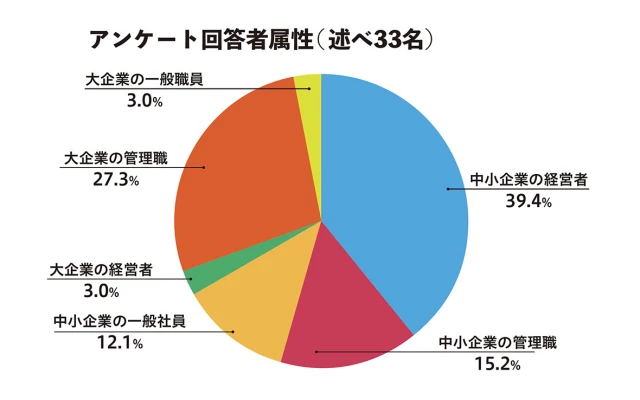
[Feedback from Participants]
・I thought it was wonderful that they embodied the idea—which seems obvious but is actually difficult—of approaching things as a unified whole, rather than separating the personal perspective of reflecting on one’s life at the end of it from the social perspective of realizing one’s goals through the family business.
・I’ve thought about how to apply the company-wide philosophy to my own workplace, but before that, I felt I needed to get my own thoughts in order.