- Speech/Session Reports
Changing the World with Materials - The Great Challenge of a Long-established Spinning Company - [National Knowledge Manufacturing Industry Conference 2025 Digest].
2026.03.02![Changing the World with Materials - The Great Challenge of a Long-established Spinning Company [National Knowledge Manufacturing Industry Conference 2025 Digest].](https://km.lne.st/wp-content/uploads/sites/81/2025/02/9ed888a230c42e7edb35ba22dc4e06fd.png)
Leave a Nest held the National Knowledge Manufacturing Conference 2025 on April 18, 2025, as a place for small and medium-sized companies and ventures to combine knowledge and create new knowledge in order to solve global problems.
The keynote speech, "Changing the World with Materials: The Great Challenge of a Long-established Spinning Company" (session partner: Hase Tora Spinning Co., Ltd.), was given by Kyouji Hase, President of Hase Tora Spinning, which has been in the spinning business in Hashima, Gifu Prefecture for about 140 years. Mr. Hase gave a speech on why a long-established company is teaming up with a venture company to engage in the knowledge manufacturing industry. This article provides a digest of this speech.
A desire to solve problems that has remained unchanged since the company's founding
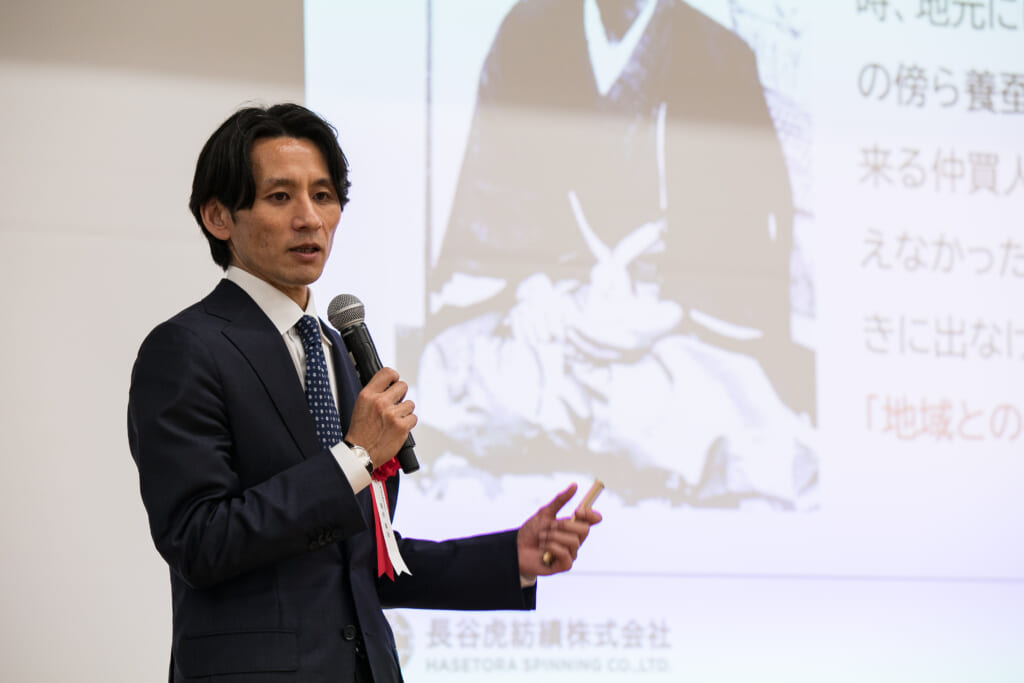
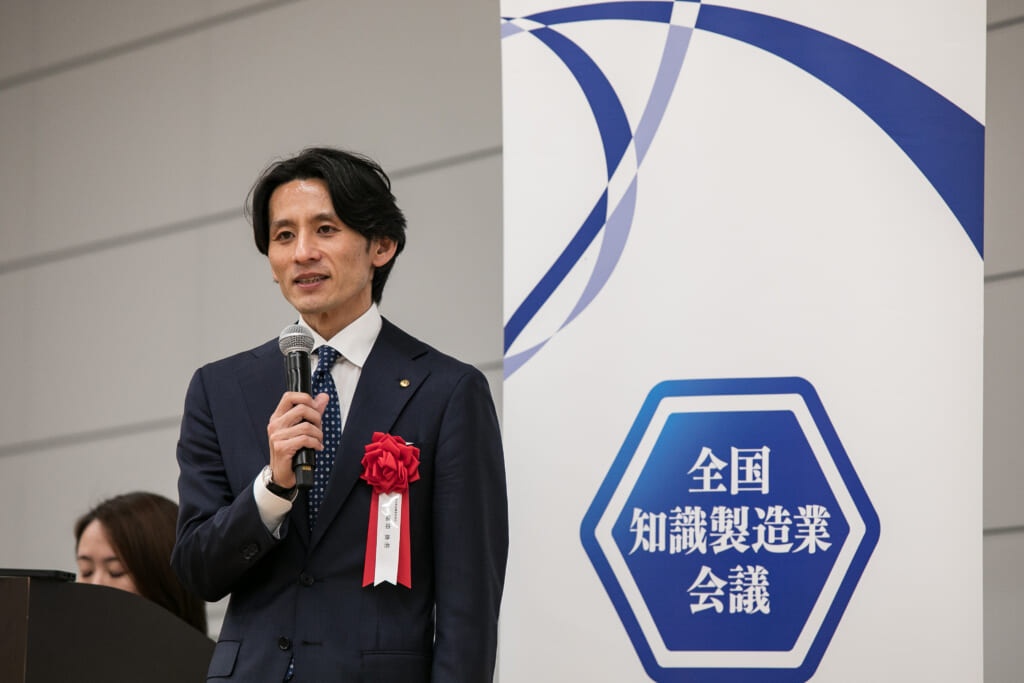
Kyouji Hase President, Hase Tora Spinning Co.
Born in Gifu Prefecture in 1980. After graduating from Reitaku Mizunami Junior and Senior High School, he went on to Reitaku University and graduated in March 2003.In April 2003, he joined Hase Tora Boseki Co. After serving as president of the Osaka branch and a subsidiary in China, he became the fifth president of Hase Tora Group in December 2019.
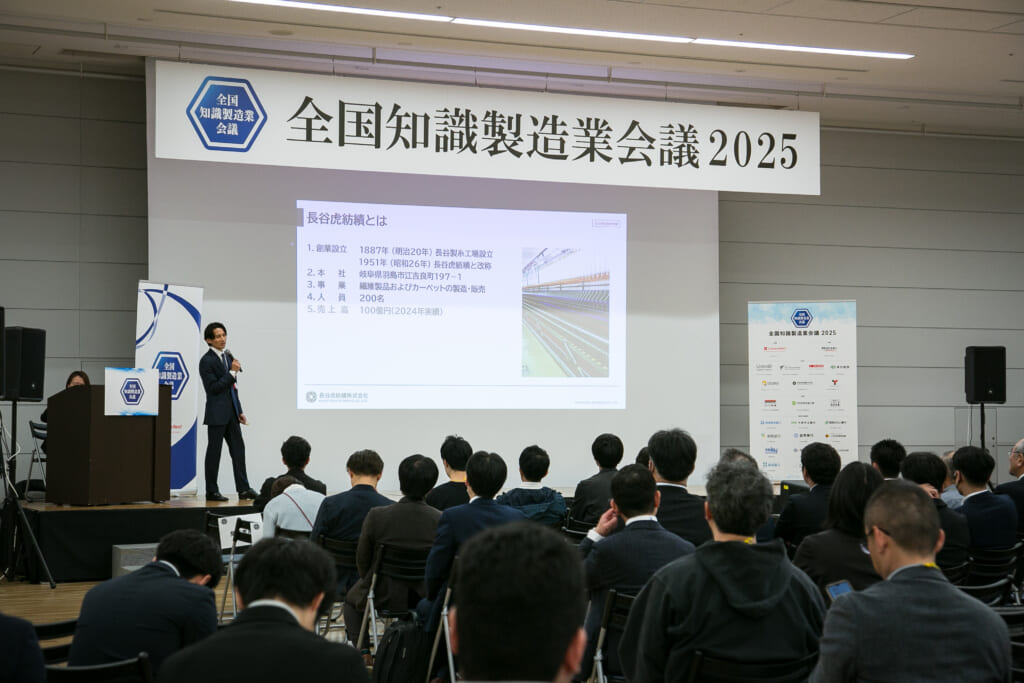
First of all, let me tell you about the origins of our company. Hase Tora Spinning was founded in 1887 by Torakichi Hase. The founder was Torakichi Hase, and his business was raw silk production.
During the founder's lifetime, the main industry in Hashima City was agriculture. People's lives were not very affluent, and farmers were engaged in sericulture as a side business. Cocoon cocoons were produced in abundance, but they were bought by middlemen from the city at a price lower than the market price. Therefore, no matter how hard they worked, they could not become rich.
Although the founder did not have the skills or knowledge to produce raw silk, he decided to establish a silk mill out of his passion to enrich the local community. He thought that if he could buy cocoons produced by local people at a fair price and employ farmers' children at the factory, the community would be enriched. There was a clear purpose in wanting to solve a social problem in the community.
Two challenges facing the spinning industry
Counting from the time of our founder, I am the fifth generation. What challenges does the spinning industry face today? At its peak in the 1960s, there were approximately 12 million weights in Japan. However, amid international price competition, production bases have shifted to overseas where labor is cheaper, and by 2024 the number will have dropped significantly to about 140,000 weights.
This photo shows the textile wholesale district in the central area of Gifu Station, which was very prosperous about 50 years ago, with buyers coming from all over Japan and even from overseas to purchase materials. However, with the downsizing of the textile industry, the streets have become sparsely populated, and the area is no longer as bustling as it once was.

Let's look at some of the global issues related to spinning and textiles. The number of apparel products produced worldwide has nearly doubled in the past 15 years. Today, the apparel industry produces more than 90 million tons of waste annually, only a small fraction of which is recycled.
In Japan, the spinning industry is shrinking, and in the world, apparel-derived waste is putting a strain on the environment. We are engaged in knowledge manufacturing with small and medium-sized enterprises and ventures to solve these social issues.
Working with a venture that has been going on for 60 years.
In recent years, the term "venture collaboration" has been heard more and more often, but we are not just following the latest fad and promoting collaboration. In fact, about 60 years ago, HASEGARA BOSHIN collaborated with a certain venture company.
The collaboration partner was a cleaning equipment rental business, later to become Duskin Inc. About 60 years ago, Duskin's founder, Seiichi Suzuki, visited various companies to find materials for his idea of a rental business for rags that could be cleaned without using water in order to reduce the burden of people's housework.
At the time, zokin were made at home using used towels and cloths, and the idea of "renting and using" them was too novel. Hase Tora Spinning was also approached about the idea, but the employee in charge of the project declined the offer. Immediately after this business meeting, Mr. Suzuki was holding his hands together in front of the monument in front of Hase Torabo's company building. When my grandfather happened to pass by and asked him about it, he replied, "I came to consult with him about starting a dustcloth rental business to reduce the burden on people. He said, "I was turned down this time, but I was so thankful that you listened to me that I was holding my hand in front of the monument.
My grandfather was moved by Mr. Suzuki's genuine desire to solve social issues and decided to cooperate. From this encounter, "Home Duskin," a chemical dust cloth, was born in 1964.
Even now we are working in collaboration with our ventures. For example, together with a Yamagata-based company called Spiber, we are developing yarn made of an artificial protein material produced by fermenting biomass. This material is characterized by its low environmental impact during production. We are also working with a company called "JEPLAN," which collects unused clothes and recycles them into raw materials for clothing.
Ventures excel at developing unique technologies and products. However, they may not have the know-how of product creation and distribution. That is why I believe it is significant for us, who have the know-how, to work with them to create businesses.
We are also promoting regional cooperation efforts, and have been collecting and recycling down and used clothing together with FC Gifu, with whom we have a sponsorship agreement. We believe it is important to collaborate with various organizations because what we can do on our own is limited.
A manager's job is to "create and take responsibility for the future."
I believe that our most important mission and role as a manager is to create and take responsibility for the future. In April 2025, Hasegoro Spinning is pleased to welcome nine new graduate employees. Eight of them are 18 years old and have just graduated from high school. In order to keep our valued employees who have chosen HASEGA Tora Boseki for the next 40 years happy, we must create the future of the company.
Hasegora Spinning has been sending out the message of "changing the world with materials" for about five years now, but we have received harsh comments from those around us that "it is impossible for a medium-sized local spinning company to change the world.
It takes a long time to realize a new future. If we look at our past, we too spent a long time developing new materials, and behind the scenes there were countless failures. However, the experience we gained from our failures is what has made HASEGARA Spinning what it is today, and what we can envision for the future.
Today, I hope to combine my knowledge with the knowledge of those gathered here to create new ideas that will change the world. Together, let us build the future.
![New era of small and medium-sized companies and ventures will change Japan and the world [National Knowledge Manufacturing Conference 2025 Session Digest].](https://km.lne.st/wp-content/uploads/sites/81/2025/03/openingsession2-1024x682.png)