- Interviews
The Manufacturing Industry is Entering the Age of Selling Knowledge
2024.01.30
Sixty years have passed since Peter Drucker proposed the concept of the “knowledge worker” in contrast to workers engaged in “manufacturing,” and the value of manufacturing is now shifting toward “knowledge” as well. Libanes, a company engaged in the “knowledge manufacturing” industry, launched its Manufacturing and Development Division in May 2020. It is taking on the challenge of redefining the manufacturing platform with the goal of transforming Japan—which is struggling amid the slump in traditional manufacturing—into a development hub that leverages knowledge.
The Ever-Changing Manufacturing Industry
Over the past 50 years or so, the environment surrounding Japan’s manufacturing industry has continued to undergo significant changes. After an era of mass production and mass consumption—epitomized by the period of rapid economic growth—the expansion of local production overseas and the development of global supply chains have progressed, while concerns have grown over the hollowing out of the domestic manufacturing sector.
Furthermore, since the publication of Chris Anderson’s book *MAKERS* in 2012, there has been a rapid increase in the number of startups entering the manufacturing sector, and the blurring of boundaries between products and services driven by the Internet of Things (IoT). As a result, society has undergone a significant transformation, shifting toward a model based on an information-driven society characterized by high-mix, low-volume production and the sharing economy.
In contrast to Western manufacturers, which have implemented digitalization and clearly separated management from manufacturing (factories), the Japanese manufacturing sector—which once flourished thanks to improvement activities based on a “front-line first” philosophy, as exemplified by Toyota’s kanban system—has been unable to adapt to the changes brought about by the information society, resulting in many Japanese companies falling behind in terms of productivity.
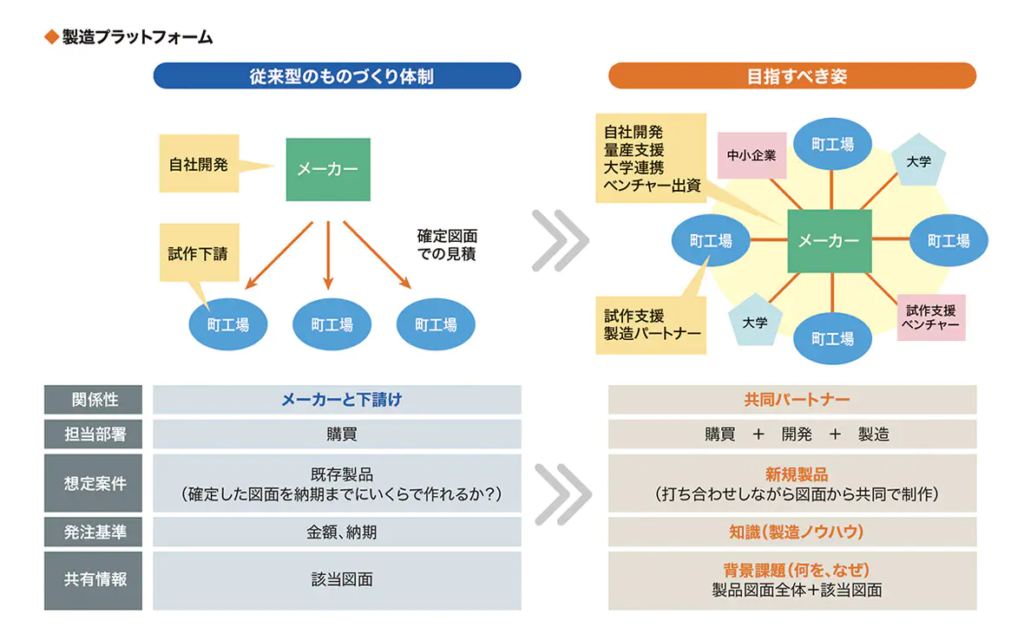
At the same time, small local factories—which in the past supported the industry by serving as subcontractors to major corporations and grew alongside them—are now facing the hardship of declining orders and are being called upon to break free from their reliance on subcontracting. What major corporations and small local factories have in common is a thirst for a new approach to manufacturing—one that differs from traditional methods—encapsulated by the term “innovation.”
What It Takes to Break Free from Subcontracting
What exactly is this new approach to manufacturing that differs from traditional methods? A clue lies in the concept of the “knowledge worker,” proposed by Peter Drucker—a renowned management scholar—in his 1960 book *The New Reality*. A “knowledge worker” is a worker who creates new added value through knowledge—in other words, a “knowledge worker”—and was portrayed in contrast to the unskilled factory labor typical of Western-style manufacturing.
Furthermore, this new approach to manufacturing is not based on manual labor in factories, but rather focuses on knowledge-based work—such as the early detection of defects during the development phase, the streamlining of setup and production processes, and the acquisition of manufacturing patents.
Lifeness reached this conclusion as it deepened its relationships with the manufacturing industry beginning in 2012. The beginning of its ambitious mission—"to disrupt the traditional structure of the manufacturing industry and build a new manufacturing platform"—stemmed from the passion of a single engineering employee who expressed a desire to "work with small local factories."
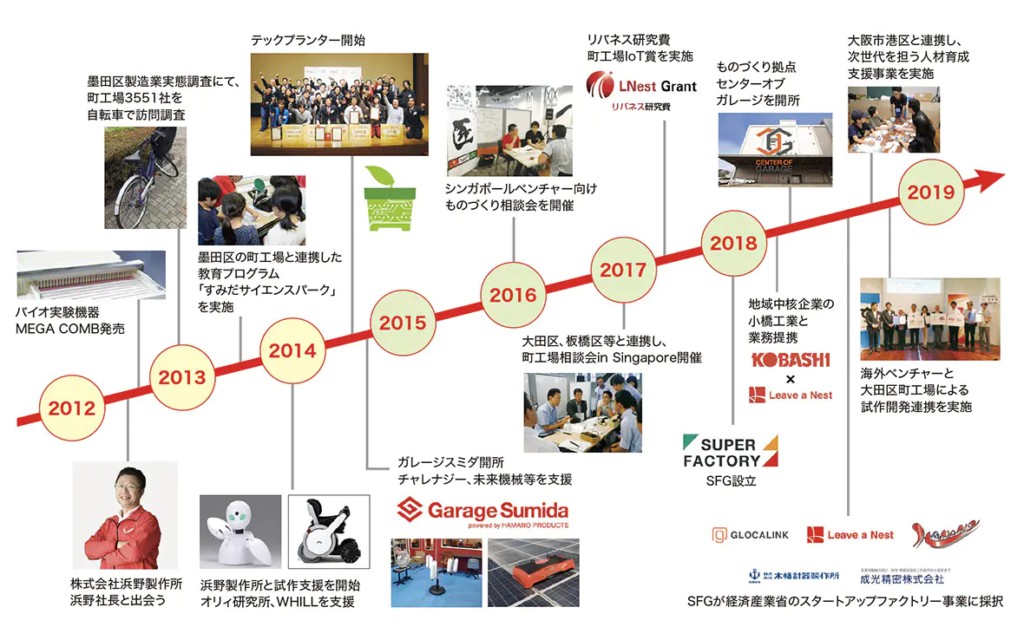
He came up with an idea to redesign the laboratory equipment used in biotechnology research—with just a few simple tweaks—to make it more efficient, and then commissioned a small local factory in Sumida Ward called Hamano Seisakusho, which he happened to come across, to manufacture it.
Since we lacked manufacturing expertise at the time, we explained the intended use and purpose and left the manufacturing method and design up to them. As a result, the “MEGACOMB”—a low-cost bio-experimentation device with significantly fewer manufacturing steps—was born, while still retaining all the functions we wanted.
It was then that I realized the depth of knowledge these small local factories possess regarding manufacturing and the importance of communication in drawing that knowledge out, and I saw great potential in a partnership between these factories and Ribane’s Science Bridge Communicators®.
Business Practices That Hinder the Unlocking of Knowledge
However, just as we sense this potential, the reasons hindering the disclosure of knowledge by small local factories also become clear. In 2013, at the request of Sumida Ward, we purchased 10 bicycles and conducted a survey over the course of one summer, visiting all 3,551 businesses in the ward.
While there are many small local factories with outstanding technical skills and experience—knowledge that helps solve on-site challenges—I witnessed firsthand just how many of them are struggling with management issues. It became clear that while many of them cite developing new sales channels as a challenge, more than half of these businesses lack the mindset to pursue new ventures and are unable to break out of the confines of their existing operations.
And the most critical issue lay in the business practices surrounding quotations in Japan’s manufacturing sector. Even though many small local factories add value through planning and design, their quotes are calculated by multiplying the unit price of parts by the quantity. As a result, when comparing, for example, quotes provided by overseas startups to factories in China or Vietnam with those from small local factories in Japan, the price of the same parts is several times higher in Japan.
In reality, there is a difference in the nature of their work between overseas factories—which provide quotes based on the manufacturing costs of the parts specified in the drawings—and small Japanese local factories, which provide the knowledge needed to solve the manufacturing challenges faced by startups and generate added value through knowledge-based labor beyond the cost of parts. However, Japanese small local factories fail to adequately explain the added value they provide because they include this value in the component cost.
In Japan, this approach to preparing quotes—which has become the norm due to the influence of supply chains headed by major corporations—that is, business practices that fail to place value on knowledge—is the very shackle holding back the Japanese manufacturing industry from making a leap forward.
Small Local Factories Can Be Partners for Startups
How can we bring to light the added value of knowledge work in existing manufacturing industries, particularly in small local factories? To address this challenge, Hamano Seisakusho—a small local factory—and Ribance partnered to launch a new business initiative: “prototyping support for startups.”
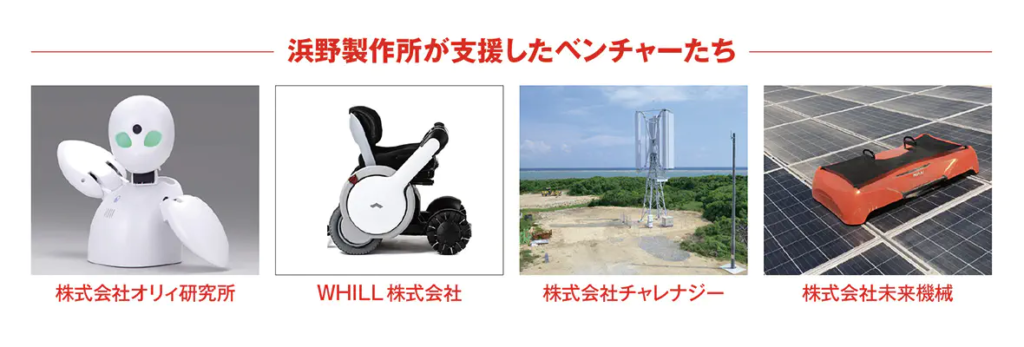
With the cooperation of Sumida Ward, Hamano Seisakusho renovated part of its facility into a venture incubation center. Using this facility, named “Garage Sumida,” the company supported the development of prototypes for WHILL—a next-generation electric wheelchair that was still relatively unknown at the time—and Ory Lab, a developer of avatar robots. The major turning point for this initiative came with the first Tech Plan Grand Prix, held in March 2014.
In this initiative, in which President Hamano of Hamano Manufacturing served as a judge, the Grand Prize was awarded to Atsushi Shimizu (currently CEO of Challenergy, Inc.). At the time, he had not yet started his business, had no partners, and lacked substantial funding; to support him, Hamano Manufacturing provided “Garage Sumida” as his base of operations and supported his manufacturing efforts from the very beginning.
After being selected for NEDO’s “Research and Development-Oriented Venture Support Program,” which had just launched at the time, we developed a prototype for a proof of concept (PoC) using that funding along with the business capital awarded as a prize for winning the Tech Planter competition. Once the prototype was complete, we attracted attention from corporations, the media, and venture capital firms, and used the funds we raised to resume manufacturing in collaboration with Hamano Seisakusho.
Hamano Seisakusho worked closely with Chalenegy to address its manufacturing challenges at every stage of the process, consistently solving these issues not as a subcontractor but as a partner. The company successfully secured funding from venture capitalists and has since developed a 10-kW unit, which it has installed on Ishigaki Island for ongoing demonstration. Additionally, it has established a joint venture with a Philippine state-owned enterprise and is proceeding with demonstrations in the Philippines.
This has proven that small local factories can team up with startups to become partners and that they are capable of creating value based on their expertise.
A Network of Small Local Factories Spanning All of Japan
In 2015, just as the TV drama “Shitamachi Rocket” was a huge hit, the story of a small local factory partnering with a startup to grow was featured in various media outlets, rapidly increasing its profile. Since then, many startups—including Mirai Machinery, which develops solar panel cleaning robots, and the drone startup AeroNext—have accelerated their manufacturing efforts with the support of Garage Sumida.
In 2018, Garage Sumida’s initiative received the Minister of Economy, Trade and Industry Award at the 7th Japan Manufacturing Awards. Furthermore, Emperor Heisei visited Hamano Seisakusho—a small local factory—as a “venture support facility,” and the initiative’s importance came to be recognized nationwide.
Also that same year, Lifeness, together with its subsidiary Grocalink, opened “Center of Garage,” a venture incubation facility specializing in manufacturing in Sumida Ward, establishing a hub to connect local small factories with manufacturing ventures around the world.
Driven by a desire to share Hamano Seisakusho’s expertise and success stories with many small local factories and to support those with a strong sense of purpose, we established the Super Factory Group (hereinafter “SFG”) in partnership with Hamano Seisakusho and embarked on the challenge of expanding the Garage Sumida brand to other regions.
Garage Taisho (operated by Kibata Keiki Seisakusho Co., Ltd.), which specializes in medical-engineering collaboration; Garage Ota (operated by Sankei Engineering Co., Ltd.), a specialist in thermal fluids; and Garage Minato (operated by Seiko Precision Co., Ltd.), which excels in regional collaboration that extends beyond the manufacturing sector—the area is home to a diverse array of unique small local factories. Each is taking on the challenge of manufacturing by leveraging its own unique strengths, and they are fostering mutual growth through the sharing of their expertise.
SFG has also been selected for the Ministry of Economy, Trade and Industry’s “Startup Factory Establishment Project”—an initiative designed to help startups and other companies overcome the “barriers to mass production” by establishing support centers for design and prototyping—and is recognized as one of Japan’s leading venture support groups, having produced numerous success stories. The companies selected for this METI initiative include not only large corporations but also many small local manufacturers, and the fact that these small local manufacturers can now serve as partners for startups is becoming a widely accepted concept.
Furthermore, in Tokyo, the company is collaborating with local governments such as Sumida Ward, Ota Ward, and Itabashi Ward, and in Osaka, with Minato Ward and others, expanding its efforts into medium- to long-term initiatives aimed at revitalizing the manufacturing industry—including identifying overseas market needs and implementing educational programs for the next generation.
The next hurdle is “mass production.”
Although collaboration with small local factories has helped identify the optimal solution for supporting startups with prototyping, the next challenge identified is the “barrier to mass production.”
This is an issue that SFG has been addressing through a process of trial and error. In recent years, major corporations have begun offering services that utilize their idle factory space to support mass production for startups, but there have not yet been sufficient reports of successful cases.
Against this backdrop, Libanes has continued to explore the nature of the “barriers to mass production.” While attention is often focused on the difficulty of bridging the manufacturing gap between prototypes and mass-produced products, we realized that the term “mass production” carries different meanings for small local factories (parts manufacturers), large corporations (manufacturers), and startups.
For example, for a small local factory, mass production is the process of manufacturing multiple identical products, whereas for a large corporation, it is the process of continuously manufacturing and selling multiple identical products.
In contrast, for startups, the term “mass production” often refers to the manufacturing phase that follows prototyping, and they frequently do not—or are unable to—consider how long they will continue to manufacture and sell the same product thereafter. Because of this difference, even if a small local factory provides support, it cannot assist in determining the optimal specifications since the startup lacks a clear sales strategy.
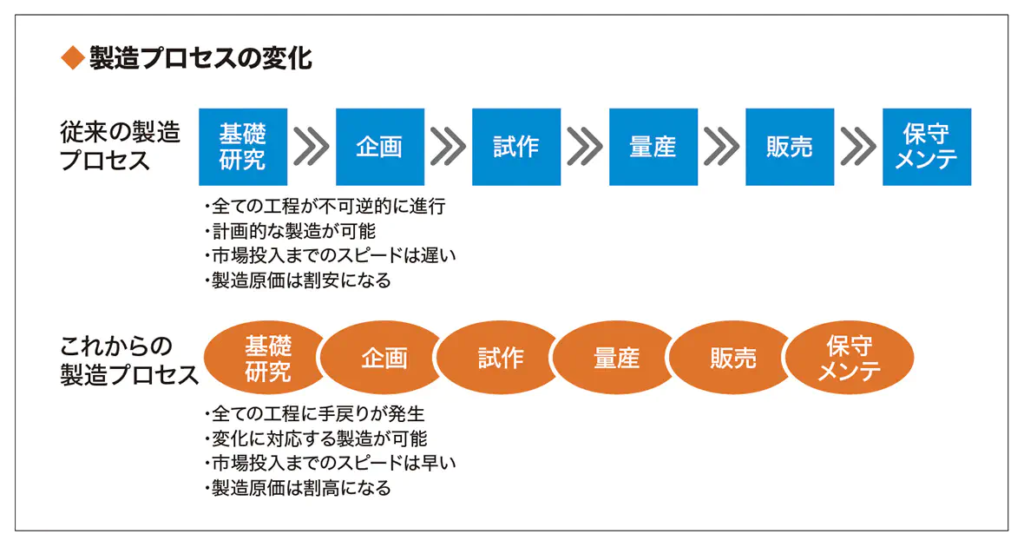
At major corporations, prices are set with consideration for the profits generated by decades of sales following mass production; the process—from research and development through prototyping, mass production, and sales—proceeds irreversibly, and mass production generates profits over a long period of time.
However, in the case of startups, new prototype ideas may emerge during mass production, leading to rework; furthermore, there may be a parallel process of revising the product specifications themselves due to changes in the perception of challenges. Above all, there is no guarantee as to how long the manufactured products will continue to sell.
In other words, the study concluded that the barrier to mass production is not a matter of quantity, but rather a communication gap between the traditional manufacturing model—which is based on mass production and mass consumption (such as small local factories and established manufacturers)—and the new manufacturing model—which is based on the information society and features high-variety, small-lot production and the sharing economy (such as startup companies).
Compared to overseas manufacturing, where roles are clearly divided between planning and design teams and factories—with factories characterized by their strict adherence to designers’ instructions—this friction is particularly pronounced in Japan, where factories—ranging from small local workshops that manufacture parts to large corporations that operate as manufacturers—possess strong in-house expertise.
However, if we can bridge that gap, we should be able to establish a new model of manufacturing as a knowledge-based industry that other countries cannot replicate.
The Key Lies with Niche-Leading Manufacturers That Serve as Regional Pillars
Meanwhile, the third force in venture support—as revealed through the Regional Tech Planter program that Libanes is rolling out across various regions—is comprised of niche-leading manufacturers whose characteristics differ from those of both small local factories and large corporations.
These companies are manufacturers with the No. 1 market share in specific niche fields, and under the leadership of owner-presidents, they handle everything in-house—from research and development to sales. They maintain a network of local small manufacturers specializing in parts machining and are regarded as key drivers of the regional economy. Furthermore, compared to large corporations, they make decisions more quickly, and their smaller size facilitates collaboration between departments such as development, procurement, manufacturing, and sales.
Kobashi Industries, which manufactures and sells agricultural machinery and parts in Okayama Prefecture, is promoting partnerships with venture companies such as Euglena and AeroNext, and has also invested in several of them. With annual sales ranging from several billion to tens of billions of yen, the company has the potential to achieve growth that surpasses that of today’s major corporations through these partnerships with venture companies.
With small local factories possessing strong design capabilities and specialized technologies joining forces with regional core manufacturing companies like Kobashi Industries—which ensure quality for mass production and offer flexible responsiveness—a path is now emerging toward establishing a manufacturing platform capable of handling everything from prototyping and development to mass production in various regions.
Rather than a system based on optimizing traditional manufacturing, it is essential to create a system grounded in knowledge-based manufacturing. To achieve this, we must address various challenges, including building partnerships—as opposed to the subcontracting relationships typically seen between large corporations and small local factories—clarifying the added value that the manufacturing sector should convey in its quotes, developing mass-production models best suited for startups, and determining the appropriate form of collaboration with universities.
The new manufacturing platform that emerges once these challenges are resolved is expected to propel the manufacturing industry into a new phase.
Toward the Realization of Inbound Globalization
Will the new manufacturing platform be viable on a global scale? We are also conducting a parallel investigation to answer that question.
In 2017, we took President Hamano of Hamano Manufacturing to the Tech Plantar event in Southeast Asia, which had just begun at the time, and launched a consultation program for small local manufacturers, targeting seven of the startups that had presented at the final selection round in Singapore and were specifically focused on addressing challenges in manufacturing.
Startups brought in a variety of inquiries, which Livanes members translated, and President Hamano responded to. Among the cases, President Hamano replied “no” to only one—one that was physically impossible—and many of the inquiries involved matters that were not difficult for small Japanese manufacturers to handle.
Furthermore, starting in 2018, we launched the “Project to Investigate Opportunities for Collaboration Between Local Companies and Overseas Startups,” commissioned by Ota Ward. Through this project, aimed at resolving manufacturing challenges faced by overseas R&D-oriented startups using the know-how and technology of Ota Ward’s small local factories, we provided prototype development grants and support to overseas startups.
Three startups selected from 52 applications submitted by six Southeast Asian countries collaborated with small local manufacturers in Ota Ward—which have strong networking capabilities—to carry out prototype development over a period of approximately six months. As a result, they successfully produced prototypes that met the expectations of the overseas startups.
These results lead to the conclusion that the manufacturing expertise possessed by cutting-edge manufacturers can be leveraged to develop the “deep tech” needed to solve the deep-seated issues in Southeast Asia.
By attracting Southeast Asian startups to Japan and integrating them with niche-leading manufacturers that serve as regional hubs and “super factories,” we seamlessly resolve challenges ranging from prototyping to mass production. Southeast Asian startups will then use the resulting products to spread their wings and take flight on the global stage.
In a future where “inbound globalization”—connecting Japan with Southeast Asia’s market of 650 million people to create new value—has become a reality, an era in which the manufacturing industry sells knowledge will likely be the norm.
![New era of small and medium-sized companies and ventures will change Japan and the world [[Knowledge Manufacturing Conference 2025 Session Digest].](https://km.lne.st/wp-content/uploads/sites/81/2025/03/openingsession2-1024x682.png)