- Interviews
Connecting Japan's former brilliance to the future through knowledge manufacturing
2024.03.17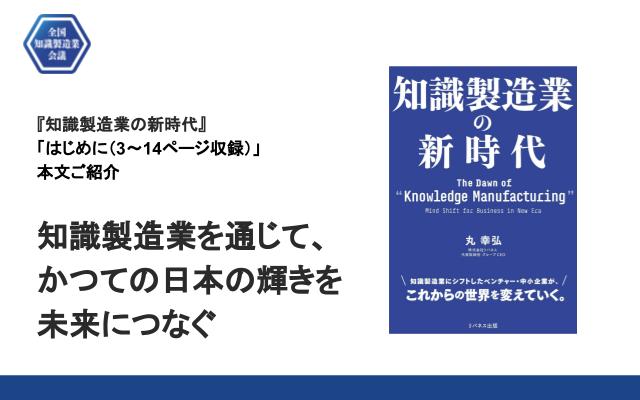
*A New Era for the Knowledge-Based Manufacturing Industry* is the official handbook of the National Conference on the Knowledge-Based Manufacturing Industry. This book explains what the “knowledge-based manufacturing industry” is, what we aim to achieve through the shift toward it, and how we should proceed with this transition. Below, we present the “Introduction” from pages 3–14 of this book.

"I have to find a way to change."
"If things keep going this way, we have no future."
Small and medium-sized enterprises across Japan share this sense of crisis. The days when the Japanese economy—centered on manufacturing—was hailed worldwide as “Japan as Number One” are now nothing more than a “fairy tale,” and even the collapse of the bubble economy, which marked Japan’s fall from the pinnacle, occurred 30 years ago. Unable to find a way to recover from that shock, Japan has spent 10, 20, and 30 years in a period known as the “Lost [Number] Years,” and this has now become the norm.
At the same time, a new wave of change is beginning to sweep through society. For example, even if people don’t know the details, everyone is familiar with the term “SDGs” (Sustainable Development Goals). At the same time, concepts such as “sustainability” and “sustainable development”—which the SDGs promote—have quietly taken root in society. The same is true for concepts such as diversity and inclusion. If we look back 10 years, the situation was certainly not like this at all.
Born in 1978, I am currently 45 years old. In the 20th-century world where I spent my childhood, the goal was “growth.” The primary indicators of this were GDP and GDP growth rate. Gross Domestic Product—in other words, the concept that “how much we produced” and “how much profit we made” equate to growth, prosperity, and, by extension, happiness. Comparing these figures on a “domestic” basis—that is, on a country-by-country basis—has long served as a measure of prosperity.
To say that production volume equates to wealth is, when you look at it another way, the same as saying that wealth is determined by “how much one can consume.” Simply put, the more robust consumption is, the more production will grow due to the relationship between supply and demand. This is why so-called “wealthy people” are seen as symbols of success. Furthermore, in terms of GDP, only the volume of production serves as an indicator; the nature of that production is never questioned.
In contrast, the SDGs assert that sustainability itself is both a value and a goal. There is no concept of seeking quantity here. Nor is the emphasis placed on growth. It’s about development, not production; it’s about sustainability, not growth. Personally, I see this as the essence of the message conveyed by the SDGs.
The generation that came of age after 2000 is known as the Millennial generation. Following them is Generation Z. For the majority of these generations, the value of “sustainability over growth” is something they can readily embrace. For Generation Z, this value has already become second nature.
By 2025, the population of Millennials and younger generations—who hold these values—will account for more than half of Japan’s workforce (working-age population). This will likely mark a turning point in which Japanese values undergo a significant shift. Then, around 2026, when the effects of this shift actually begin to ripple through society, the realization that “the times have changed” should become clear.
Incidentally, globally, by 2025, Millennials and younger generations will account for more than 75 percent of the workforce. People’s values will never go back to the way they were.
For Japan to make a comeback, it must thoroughly understand these changes and successfully ride the wave of the times. The most important key to achieving this is changing our mindset.
So, how should we shift our way of thinking? The answer lies in the concept of the “knowledge-based manufacturing industry.” We at Ribane Co., Ltd. define this concept as follows:
Creating new knowledge by combining existing knowledge. And using that new knowledge to solve unresolved problems.
I believe that, moving forward, all industries in Japan should shift toward becoming knowledge-based manufacturing industries. Through the knowledge-based manufacturing sector, we should solve the mountain of unresolved challenges facing the world and once again become indispensable to the global community. And the key players in this effort will be small and medium-sized enterprises (SMEs), which account for 99.7 percent of all Japanese companies. The purpose of this book is to share this idea with you and work together to build a new era of knowledge-based manufacturing.
The Knowledge Industry: Something Anyone Can Get Involved In
To introduce myself briefly, I founded Ribane Co., Ltd. in 2002 together with 15 colleagues. I’ll go into more detail about Ribane in the chapters that follow, but for now, here are its five key characteristics:
- A startup founded in 2002 primarily by graduate students in science and engineering, it remains a group of researchers in which all employees hold either a Ph.D. or a master’s degree.
- Since its founding, the company has upheld the vision of "advancing science and technology and contributing to the planet."
- The company operates four core projects titled “Education Support,” “Talent Support,” “Research Support,” and “Startup Support.”
- Through each of these projects, we have built an extremely broad knowledge network that spans school settings, young researchers, various research institutions, startups, small local factories, small and medium-sized enterprises, and large corporations.
- The company has subsidiaries in Singapore, Malaysia, the Philippines, the United Kingdom, and the United States, and operates similar businesses globally.
What I’d like you to focus on is that Ribane’s business scope is far broader than one would normally expect (if this were a consulting firm, they would likely be the first to point out that “the company should select and focus on specific businesses and concentrate its resources there”).
As a result, we have indeed built a network that spans a far wider area than would normally be conceivable. Moreover, we have expanded this network not only in Japan but also globally. Furthermore, we have accumulated a wealth of knowledge through 20 years of consistent, unwavering activity since our founding in 2002.
In addition to my work at Lifeness, I have been involved in the founding of more than 70 startups to date. The first of these was euglena Co., Ltd., established on August 9, 2005. The journey with Euglena—which has since grown into a company with a market capitalization of over 100 billion yen on the Tokyo Stock Exchange Prime Market—has been a truly significant experience for both me and Lifeness.
Given these circumstances, I currently hold three main titles. The first is Representative Director and Group CEO of Ribance Co., Ltd. The second is Chief Research and Development Officer (CRO), a specialized executive position I currently hold at the aforementioned Euglena Co., Ltd. And third, I am the Representative Director of RealTech Holdings Co., Ltd., the management company for the RealTech Fund, which was launched in 2014 by three companies: euglena Co., Ltd., Ribance Co., Ltd., and SMBC Nikko Securities Inc.
However, as a general rule, I always introduce myself as “Yukihiro Maru, Representative Director and Group CEO of Ribane Co., Ltd.” This is because everything—from euglena and RealTech Holdings to the more than 70 venture companies—stems from Ribane’s vision of “advancing science and technology and contributing to the planet.”
Based on all of these experiences, the conclusion I have reached regarding a strategy to revitalize Japan is the one I mentioned earlier: “All of Japan’s industries should shift toward knowledge-based manufacturing.”
While I will explain the specifics in detail later in this chapter, the first point I want to emphasize is that anyone can engage in the knowledge-based industry.
You don’t have to be a large corporation. You don’t need to have cutting-edge technology. You don’t even have to be in the manufacturing industry. This is because what the knowledge-based manufacturing industry produces is, ultimately, “new knowledge.” As those in the manufacturing industry will understand, manufacturing isn’t something that can be done simply by having machinery and equipment. It is precisely because there are people with the necessary knowledge that manufacturing becomes possible.
So, for example, even a small-town ramen shop can engage in the “knowledge-based industry.” “We’re confident in our flavor,” “We’re experts at providing prompt and efficient service,” “But the local population is declining, and the outlook for the future isn’t bright.” Let’s imagine there was a ramen shop like that in some town somewhere in Japan.
On the other hand, looking at the global picture, obesity has become a serious problem in rapidly developing emerging economies due to changes in dietary habits. Consequently, the number of people with diabetes is also rising sharply. For example, in Malaysia in Southeast Asia, the prevalence of diabetes among adults is 16%—approximately twice the global average—while in Pakistan in South Asia, the number of people with diabetes has increased more than fivefold over the past 10 years. Across South Asia as a whole, it is estimated that as many as 220 million people will develop diabetes over the next 20 years.
So, what if a local ramen shop in a town struggling with population decline were to develop healthy noodles made from konjac instead of wheat, streamline its operations through mechanization and automation, and then expand its business to South Asia with its signature flavor? Wouldn’t that local ramen shop suddenly transform into a global food chain?
Of course, this isn’t something the owner of a single shop can achieve on his own. However, there are universities all across Japan, and many of them are home to researchers working on cutting-edge food tech. Mechanization and automation of operations are precisely what small local factories all over Japan excel at. When it comes to flavor, we can simply ask people who have come to Japan from other countries—whether for study or work—to serve as taste testers. By combining knowledge in this way, even a small neighborhood ramen shop can generate new insights capable of solving global challenges.
By speaking up and saying, “I want to solve this problem,” anyone can work toward solving it. No matter what kind of knowledge it is, by combining it with other knowledge, we can solve problems around the world. This is the very concept of the “knowledge manufacturing industry.”
Carrying Japan’s Past Glory Into the Future
There are three things I want to accomplish through the “knowledge manufacturing” industry. First, I want to realize Ribane’s vision of “advancing science and technology and contributing to the planet.” Second, I want to revitalize Japan through the “knowledge manufacturing” industry. And third, I want to ensure that the knowledge accumulated in Japan over the years is passed on to future generations through this shift toward the “knowledge manufacturing” industry.
At the root of this mindset is likely a generational factor. As mentioned earlier, I was born in 1978. Since Lifenex began as a student-run startup, it goes without saying that the founding members are of the same generation. While the current Lifenex executive team includes people other than the founding members, all of them belong to the generation born between 1975 and 1986.
According to Japan’s generational classifications, those born between 1975 and 1986 find themselves squarely in a “gap” between generations. Above them is the “Baby Boom Junior” generation, which comprises a large portion of the population, and below them is the “Yutori” generation, which holds values that differ from those of previous generations. Although their youth coincided with the “employment ice age,” this generation essentially represents the transitional period from the Showa era to the Heisei era.

However, precisely because we are a “bridge generation,” we are able to understand both traditional and new values. We have respect for the Showa era shaped by our parents and grandparents, while also harboring high hopes for the new generation that will lead the way into the future. Our generation holds both a sense of urgency—that “there is no future if Japan remains as it once was”—and the awareness that “we cannot build a future without preserving the best of Japan’s past.” From this arises a sense of responsibility: “We must be the ones to bridge Japan’s past and future.” At the very least, every member of the Ribanex executive team feels this mission deeply.
As will be explained in more detail in Chapter 2, Lifeness refers to its members as Science Bridge Communicators®. What we aim to achieve through our “knowledge manufacturing” is nothing less than “building a bridge from Japan’s glorious past to the future.”
In this book, I have attempted to distill the essential elements necessary for building that bridge. In Chapters 1 through 3, I discuss one by one the key concepts—“symbiosis,” “bridging,” and “researcher’s mindset”—that are indispensable for the shift toward a knowledge-based economy.
Chapters 4 through 6 build on these concepts to explain the actions companies should take moving forward. The key terms for each chapter are “Deep Tech,” “4D Thinking,” and “Inbound Globalization,” respectively.
Chapter 7 focuses on building the kind of organization needed to realize a “knowledge-based industry.” What kind of organization should companies build going forward? And what kind of messages should top executives convey to create such an organization? This chapter should also prove useful when considering business succession planning.
If small and medium-sized enterprises—which account for 99.7 percent of Japanese companies—can successfully transition to a knowledge-based manufacturing sector, Japan will surely make a comeback. And as a result, global challenges will be resolved one after another, paving the way for a prosperous and bright future. I look forward to building this new era together with all of you.
My introduction has gone on a bit longer than intended. Let’s now move on to this chapter, which explains the concepts needed to step into the “New Era of Knowledge Manufacturing.” I’ll do my best to guide you every step of the way so that, by the time you finish reading the final Chapter 7, you’ll truly feel, “Is this the gateway to a new era?”