- Interviews
Collaboration Case: Sanko Giken and Amplat] Jointly developed "Chatbot" that answers any questions about punching in only 4 months.
2024.08.29
Sanko Giken Co., Ltd. and Anplat Co., Ltd., which exhibited at the National Knowledge-Based Manufacturing Conference 2024 held in April 2024, jointly developed “Sanko-kun”—a chatbot that can answer any question about precision punching—in a remarkably short span of just four months. How did these two companies—united by a shared passion to “advance Japan’s manufacturing industry through a combination of knowledge and technology”—put the concept of “knowledge-based manufacturing” into practice? Here, we present their firsthand accounts.
*This article summarizes the content of a follow-up seminar for exhibitors at the 2024 National Knowledge-Based Manufacturing Conference.
Sanko Giken: Professionals in "Punching"
Length:We will now begin the “National Knowledge Manufacturing Conference 2024 Online Seminar.” Thank you all for joining us. First, let me take a moment to explain what the National Knowledge Manufacturing Conference is all about. At Lifeness, we advocate the concept of “knowledge manufacturing”—the process of creating new knowledge by combining existing knowledge to solve unresolved challenges.
The National Knowledge-Based Manufacturing Conference is a forum where medium-sized and small businesses, startups, and financial institutions from across the country gather to share and discuss the concept of knowledge-based manufacturing and how to put it into practice. The conference, held on April 12, 2024, was a resounding success, drawing 418 participants despite being the first-ever event of its kind.
For this seminar, we were joined by Mr. Kei Tanaka of Sanko Giken Co., Ltd. and Mr. Takuma Misawa of Unplat Co., Ltd., who launched their new service, “Sanko-kun,” in June 2024 following a connection they made at the 2024 National Knowledge-Based Manufacturing Conference. First, please introduce yourselves.
Mr. Takashi Tanaka, President and CEO of Sanko Giken Our company, located in Higashiosaka, is now in its 47th year of operation. We are experts in precision die-cutting and possess a wide range of processing technologies related to all types of “die-cutting,” including dies, presses, and Thompsons. We also propose the most suitable manufacturing methods, taking into consideration both the costs associated with die-cutting and the customers who will use the products. Among the representative products we have produced are Suica and ICOCA transit IC cards. To date, we have manufactured over 100 million IC cards through press processing, delivering them with zero complaints—a testament to our high quality.
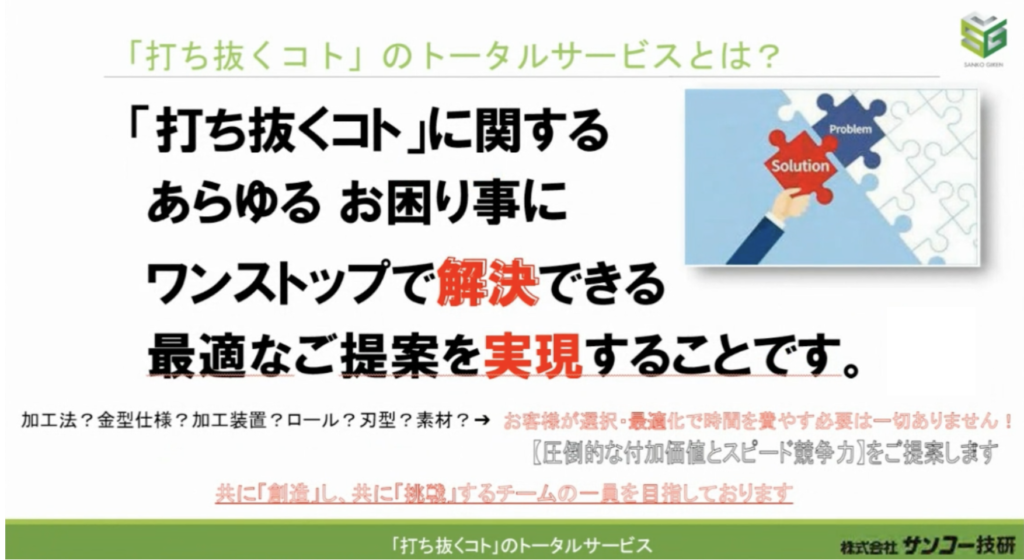
We are also working to promote digital transformation (DX) in the manufacturing industry and have been offering the daily report and labor hour management app “SmaFak!” since 2020. The impetus for its development came from the fact that our employees were recording daily reports—including work details and hours—by hand, and we wanted to digitize this process. Once we began using the app internally, we received a lot of feedback saying it was “very convenient,” so in 2020, we named it “SmaFak!” and began selling it externally. By affixing QR codes to machinery, the app now provides an at-a-glance overview of how much time was spent on each task, and is designed to enable users to plan their work based on that information.
Unplat: Providing Researchers with a Wide Range of Analytical Methods
長 With their outstanding precision punching technology and their commitment to digital transformation as a new challenge, I felt they were truly at the forefront of the manufacturing industry. Next, Mr. Misawa of Unplat, please introduce yourself.
Mr. Takuma Misawa, President and CEO of Unplat In general terms, our company falls under the category of an IT company. While the nature of our business is somewhat complex, one of our core technologies is bioinformatics analysis. Bioinformatics is a field that integrates life sciences and information science, and includes areas such as genetic analysis. We provide services to researchers, physicians, and others, focusing on three key areas: “DX for analytical methods,” “SaaS for analytical methods,” and “platforms for analytical methods.”
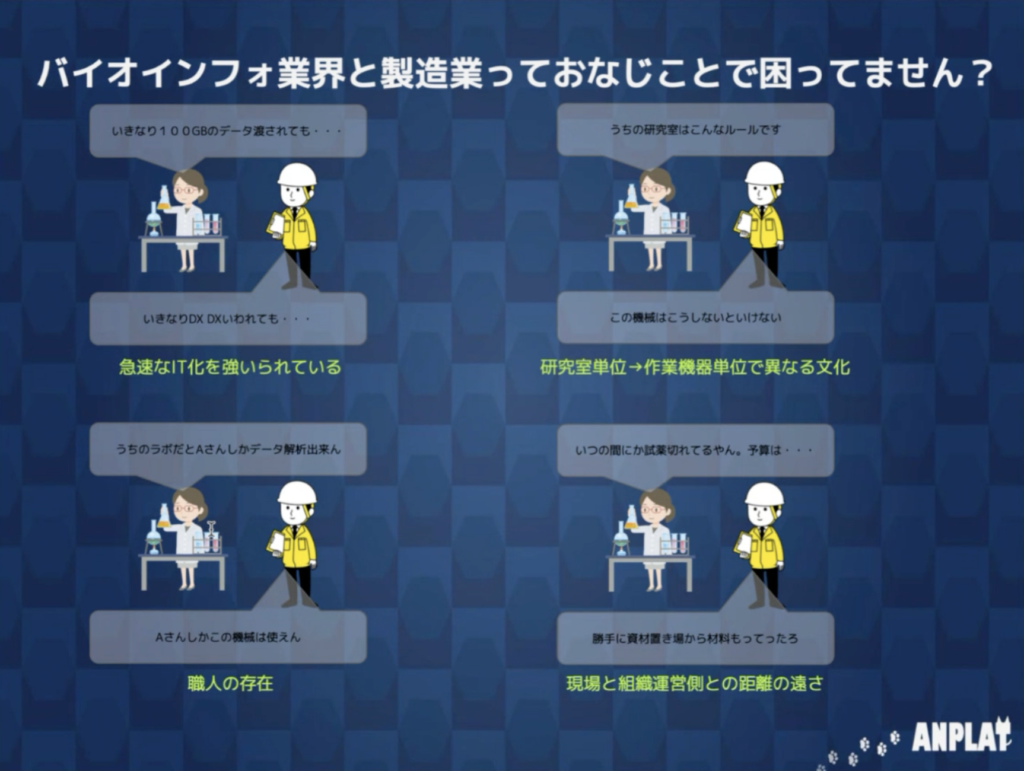
The reason we offer these services is that we have entered an era focused on advancing digital transformation (DX), and this trend is now sweeping through the life sciences research industry as well. Currently, research in the life sciences is conducted on the premise of acquiring and analyzing hundreds of gigabytes of data from specialized equipment. In other words, researchers must first obtain or develop the appropriate software before they can even reach the starting line of their research. To support this research community, our company provides “ANCAT,” a data analysis technology-sharing platform that enables intuitive handling of all types of data analysis—including bioinformatics—and develops and operates life science data analysis systems.
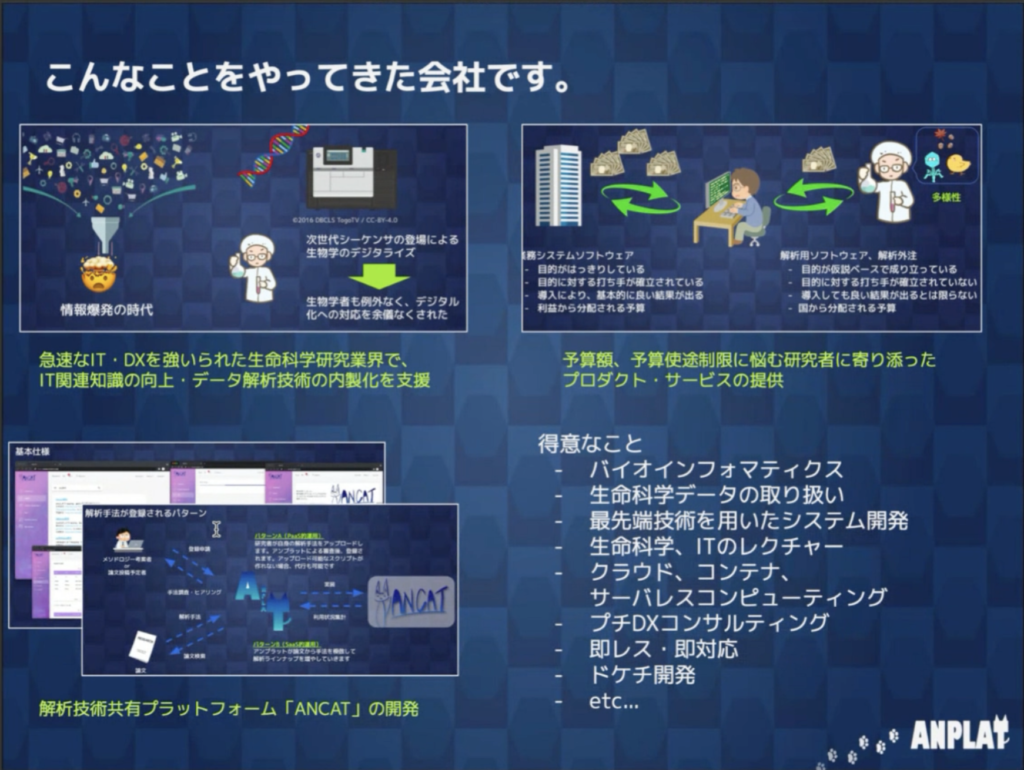
So, why did we participate in the National Knowledge-Based Manufacturing Conference, where many companies in the manufacturing sector exhibit? For example, even if a researcher we’ve supported discovers a new material, that researcher doesn’t have the means to “manufacture” it. If they cannot produce the actual product, it means they cannot deliver their research findings to the general public. To help solve this challenge, we decided we wanted to connect with people in the manufacturing industry first and foremost, which is why we participated in the National Knowledge-Based Manufacturing Conference.
As I spoke with Mr. Tanaka and others in the manufacturing industry, my impression of the sector changed. Before hearing their stories, I had imagined that high-tech machinery was widely in use, but that’s actually the case only in a few large-scale factories. The backbone of Japan’s manufacturing sector is made up of people like artisans who have spent years honing their skills. Furthermore, in small town factories, paper is still the norm for administrative work, and some places haven’t even adopted IT yet. I realized that when it comes to delivering services to people who aren’t IT specialists, the bioinformatics industry and the manufacturing sector are no different—they both face similar challenges.
"Fun" is the ingredient that’s spicing up the business partnership between the two companies
長 Please tell us about the service you've just launched.
TanakaIn August, we released “Sanko-kun,” a chatbot that uses the data we’ve accumulated over the years to answer any questions about precision die-cutting.
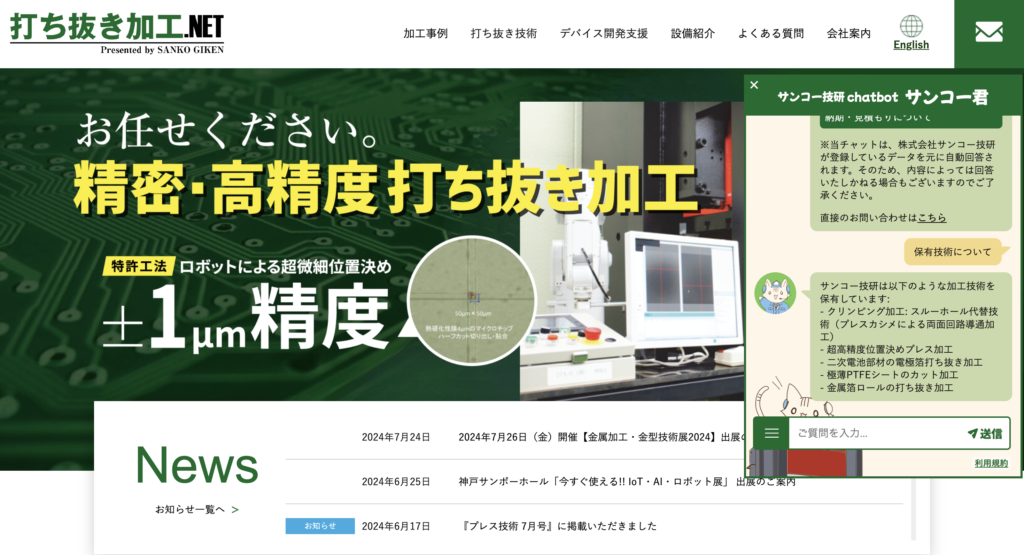
Precision and High-Precision Punching Services Page"Sanko-kun" has been added to the game
長 How did this collaboration come about? I understand that the two of you first met at the National Conference on Knowledge-Based Manufacturing. What did you talk about at first?
TanakaIt all began when we discussed our respective businesses and I suggested, “Couldn’t we put the data we’ve accumulated on precision die-cutting to some use?”
MisawaAfter the National Knowledge-Based Manufacturing Conference, we took the initiative to propose a meeting, expressing our desire to “learn more about precision die-cutting.”
長 How did the planning and development proceed from there?
TanakaFirst, we provided Mr. Misawa with 15 years’ worth of our company’s data—including machine manuals, process charts, quality-related documents, sales materials, and information from our website—and went through the process of having the program learn from all of it. As a result, we completed “Sanko-kun,” a chatbot that can answer any question related to “punching.”
MisawaIt was a lot of fun working on this project with Mr. Tanaka. He’s a truly charming person who kept coming up with humorous ideas. For example, when the chatbot was asked a question that wasn’t covered in the data, we were struggling to figure out how to have it respond, and at first, we tried to generate a generic answer using AI. However, we agreed that “that would be boring,” so he suggested, “Since Sanko Giken is an Osaka-based company, and we’re using a cat icon for the chatbot this time, how about having it reply, ‘I don’t know, meow’?” (laughs).
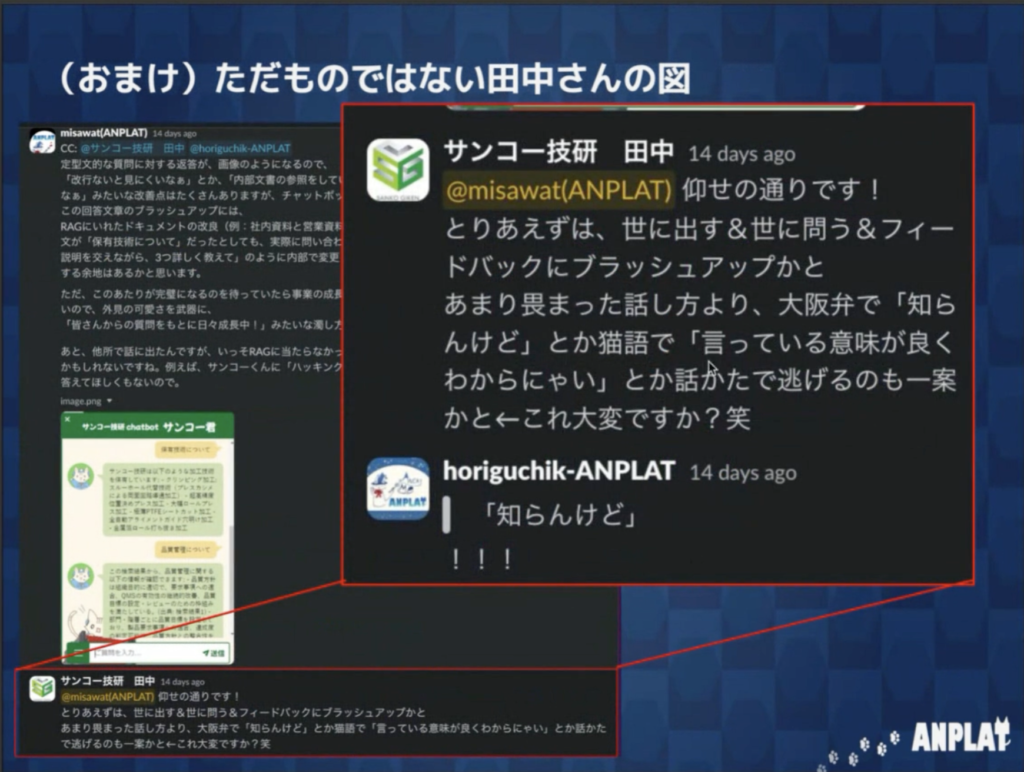
While it’s certainly important to tackle problems seriously, it’s also crucial to approach them with a sense of playfulness. We exchanged ideas like this on Slack almost every day, which allowed us to release the product in just about four months.
A Future Where the Entire Manufacturing Industry Converges on Chatbots
長 Please tell us what your vision is for the service going forward.
Tanaka We completed the implementation of the Precision and High-Precision Punching Services page on August 23, so from now on, we plan to make some minor refinements. We exhibited the beta version of Sanko-kun at the “Ready to Use Now!! IoT, AI, and Robotics Expo” held on June 28, 2024, and had many people try it out—it was a huge hit. Now that the implementation is complete, we’re looking forward to having even more people experience it.
I’m always thinking about how I can contribute to Japan’s manufacturing industry. Currently, our chatbot is based solely on our company’s data, but in the future, I’d like to develop a chatbot that incorporates a wide range of technologies and knowledge. I imagine that one day, workers on the manufacturing floor will be able to ask anything simply by carrying a single smartphone. By creating a repository of technology and knowledge, I want to help drive the advancement of Japan’s manufacturing industry.
MisawaOne of the key concepts behind Unplat’s vision is “knowledge sharing.” Normally, companies tend to want to keep their proprietary technologies and knowledge under wraps. However, Mr. Tanaka said, “We want to actively share our knowledge,” and I felt that this aligns perfectly with the “knowledge sharing” we aim to achieve. We want to make knowledge openly available to foster growth across Japan as a whole. I’d like to work with Mr. Tanaka to create that kind of momentum.
LongTo address the challenge that technical expertise and knowledge in the manufacturing industry are often not made visible and are difficult to share, Mr. Tanaka and Mr. Misawa are using a chatbot to provide an “environment for sharing knowledge without relying on people.” Sanko-kun was born from the combination of Sanko Giken’s expertise in “punching” and the knowledge of Unplat, which has been conducting data analysis under the banner of “knowledge sharing.” This is truly a practical example of the “knowledge-based manufacturing” concept. I look forward to seeing their initiatives expand even further. Thank you very much for joining us today!
![National Knowledge Manufacturing Conference 2024] Case Study of Collaboration Vantec, Inc. ✕ Kankyo Inland Water Resources Research Institute, Inc.](https://km.lne.st/wp-content/uploads/sites/81/2025/04/006ec38f574fa64839bbf8abfdc8ba8e-1024x682.png)
![National Knowledge Manufacturing Conference 2025] 60 Exhibiting Companies to Participate! Call for visitors!](https://km.lne.st/wp-content/uploads/sites/81/2025/04/d9d01fb31e9454aeb1cbaa1b8c09511c-1024x682.png)
![National Knowledge Manufacturing Conference 2024 - First Results] Sanko Giken Co., Ltd. and Amplat Corporation Jointly Developed "Sanko-kun," a Chatbot for Precision Punching](https://km.lne.st/wp-content/uploads/sites/81/2024/08/f2690698d75451b6abeb915f81822f81.png)